

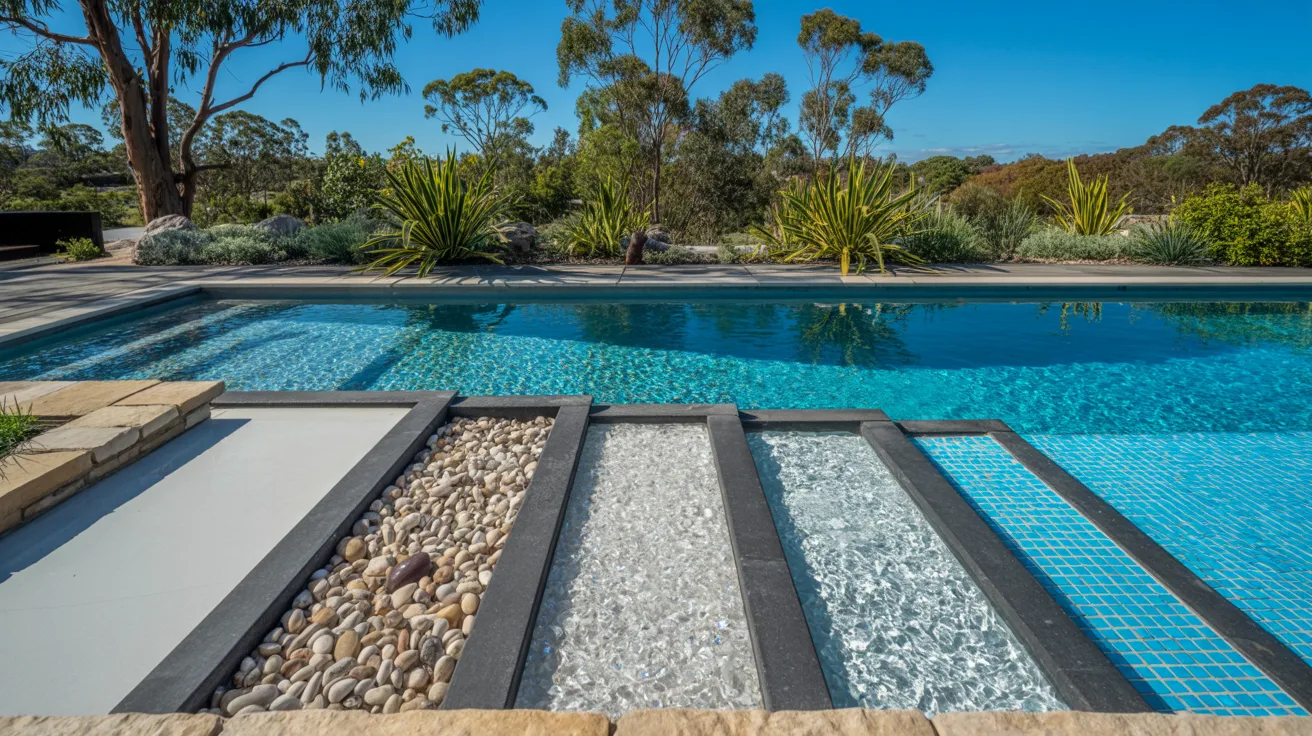
Most people spend weeks choosing their pool shape and size. The finish gets far less attention, and it deserves more. It shapes how your pool looks, feels, and performs every day – and how long before it needs serious work.
This guide covers every finish type used in Australian pools, what each one delivers, and how to choose the right option for your situation.
Key Takeaways
- Fibreglass pools: have a built-in gelcoat surface that is smooth, non-porous, and lower maintenance than any applied concrete finish.
- Concrete pools: need a separate applied finish (plaster, quartz, pebble, tile, or paint), each with different costs, textures, and lifespans.
- Pebblecrete and quartz: offer the best durability for concrete pools. Plain plaster is cheaper upfront but needs resurfacing sooner.
- Pool paint: is a short-term solution. It costs less upfront but needs recoating every 3 to 7 years and can limit your future resurfacing options.
- Resurfacing costs: vary widely depending on finish type, pool size, surface condition, and location. Always get multiple detailed quotes.
- The right finish: comes down to your pool type, budget, how long you are staying, and how much ongoing maintenance you are willing to take on.
What Are Pool Finishes?
A pool finish is the interior surface layer: the material lining the inside of the shell that you see and feel every time you use the pool. It is one of the most consequential decisions in pool ownership because it touches almost every part of the experience.
The finish determines how the water looks. A light surface scatters light differently than a dark one, producing anything from a bright tropical turquoise to a deep, dramatic near-black. The same water chemistry can look completely different depending on what is beneath it.
It determines how the pool feels. There is a significant difference between the smooth, even surface of a quality gelcoat or fresh plaster and the texture of a coarser aggregate finish. For families with young children who spend hours in the water, that difference is felt every day.
It determines how easy the pool is to maintain. Porous surfaces absorb chemicals and minerals over time, provide footholds for algae, and are harder to keep balanced. Non-porous surfaces resist this. The finish you choose will shape your weekly maintenance routine for years.
It determines how long before it needs resurfacing. Some finishes are measured in decades; others need attention within a few years.
One distinction worth understanding before getting into the options: Fibreglass pools and concrete pools approach this question very differently.
With a concrete pool, the finish is a separate layer applied to the shell and will eventually need to be replaced. With a fibreglass pool, the gelcoat is part of the shell itself, built in during manufacturing. That difference shapes most of what follows.
Types of Pool Finishes in Australia Fibreglass Gelcoat
Fibreglass pools do not have an applied finish in the traditional sense. The gelcoat is the outermost layer of the fibreglass shell, smooth, non-porous, and formed as part of the pool during manufacturing.
Look and feel: Smooth and consistent across the entire surface. The colour is integral to the gelcoat itself, so it will not peel or flake over time. Lighter tones produce a warm, tropical water appearance; deeper tones create a more dramatic effect. Water colour also shifts with light levels, time of day, and surrounding landscaping, so it is worth viewing installed examples rather than relying on swatches alone.
Durability: With proper care, a quality gelcoat surface can last 15 to 25 years or more. The surface is engineered for UV weathering resistance and chemical resistance to chlorine and acid.
Maintenance: The non-porous surface resists algae and staining significantly better than concrete finishes. Fewer chemicals are typically needed to maintain water balance, and the surface is easier to clean.
Limitations: Fibreglass pools generally carry a higher upfront cost than entry-level concrete builds. Pools come in pre-set mould shapes, which limits design flexibility. If the shell is damaged, repairs require a specialist fibreglass contractor.
Best for: New pool buyers who want the lowest-maintenance surface over the long term and are comfortable working within available mould shapes.
Plaster / Render
White cement plaster is the most traditional finish for concrete pools and the most affordable starting point for resurfacing. It gives the classic blue-white look that most people picture when they think of a pool.
Look and feel: Smooth when freshly applied. Over time, the surface tends to roughen and discolour, often taking on a patchy or stained appearance without consistent chemical management.
Durability: Generally, 7 to 12 years before resurfacing is needed. Plaster is porous, absorbing chemicals, minerals, and organic matter, which accelerates staining and surface degradation.
Maintenance: Higher than most other options. Plaster pools require more frequent chemical adjustments and cleaning to stay on top of algae and discolouration.
Best for: Owners of concrete pools looking for the most cost-effective resurfacing option, particularly where budget is the primary consideration and longevity is less of a concern.
Quartz / Quartzon-Style Finishes
Quartz finishes blend white cement with quartz aggregate, producing a harder and more durable surface than plain plaster. Brands such as Quartzon are well established across the Australian market.
Look and feel: Smoother than exposed aggregate but with a slight texture. Available in a range of colours, from crisp whites and light blues through to darker, moodier tones.
Durability: 12 to 18 years with proper maintenance. The quartz aggregate makes the surface harder and considerably more resistant to staining than plain plaster.
Maintenance: Moderate. The reduced porosity means less chemical intervention and less frequent scrubbing than a plaster pool.
Best for: Homeowners resurfacing a concrete pool who want a meaningful step up in durability and appearance without moving to the premium end of the market.
Pebblecrete and Exposed Aggregate
Pebblecrete and exposed aggregate finishes embed small stones, pebbles, or glass beads into a cement base. The aggregate is revealed by washing the surface during curing. These are among the most popular and hardwearing finishes on Australian concrete pools.
Look and feel: Noticeably textured. Standard pebblecrete can feel rough underfoot, which some people find uncomfortable over extended use. Glass bead blends sit at the smoother, more refined end of the category and have a gem-like reflective quality.
Durability: 15 to 25 years, depending on aggregate type and maintenance. One of the most resilient concrete finishes available.
Maintenance: Relatively low. The density and hardness of the aggregate resists staining and algae better than plaster. Grout lines between pebbles benefit from regular brushing to prevent debris build-up.
Best for: Homeowners who want to resurface once and not think about it again for two decades. Glass bead blends suit those wanting that longevity with a more polished finish.
Tile Finishes (Ceramic and Glass Mosaic)
Full tile interiors represent the premium end of pool finishes. Ceramic or glass mosaic tiles are applied across the entire pool surface and sealed with grout.
Look and feel: Hard, smooth, and visually striking. Glass mosaics in particular create a reflective, jewel-like quality in the water. Highly customisable in colour, pattern, and design.
Durability: 25 years or more if grout is properly maintained. The tiles themselves rarely fail; it is the grout that requires attention over time.
Maintenance: Low for the tiled surface itself, but grout joints need regular care. Algae and mineral staining can accumulate in the grout lines if left unchecked.
Best for: Premium builds where maximum visual impact and longevity are the priority, and where the higher upfront installation cost is accounted for in the budget.
Pool Paint (Epoxy and Acrylic Coatings)
Pool paint is a coating applied directly over the surface of a concrete pool. Epoxy paints are more durable and longer-lasting; acrylic paints are cheaper and easier to apply but need replacing sooner.
Look and feel: Smooth when freshly applied and available in a limited colour range. Over time, the paint can chalk, peel, or blister, particularly if surface preparation was poor or water chemistry has not been managed carefully.
Durability: 3 to 7 years for epoxy; often less for acrylic. Widely regarded as a short-term solution rather than a permanent fix.
Watch-outs: Repeated painting over previous layers can create compatibility issues and delamination. Old paint layers can also prevent some resurfacing finishes from adhering properly, limiting your options down the track.
Best for: Short-term refreshes, pools being prepared for sale, or situations where the budget rules out resurfacing, and the surface condition does not yet require it.
Note: Polymer coating systems such as ecoFinish are an emerging category sitting between paint and traditional resurfacing. Spray-applied and more durable than standard paint, they are worth asking about when getting resurfacing quotes.
Pool Finishes at a Glance
Finish type
Typical lifespan
Maintenance
Feel underfoot
Best for
Fibreglass gelcoat
15 to 25+ years
Low
Smooth
New builds, low-maintenance priority
Full tile
25+ years
Low (grout care required)
Smooth
Premium builds, max longevity
Pebblecrete / glass bead
15 to 25 years
Low to moderate
Textured
Long-lasting concrete finish
Quartz
12 to 18 years
Moderate
Lightly textured
Mid-range concrete resurfacing
Plaster
7 to 12 years
High
Smooth when new
Budget resurfacing
Epoxy paint
3 to 7 years
Moderate
Smooth when new
Short-term refresh or pre-sale
What Is the Best Finish for a Pool?
The answer depends on your pool type, priorities, and how long you plan to own the home. For fibreglass pools, the question is really about colour rather than material. For concrete pools, the right answer varies by situation.
If your priority is…
The right finish is…
Lowest maintenance overall
Fibreglass gelcoat
Maximum durability on a concrete pool
Pebblecrete or glass bead blend
Premium look with a long lifespan
Full tile or glass bead blend
Best value over 15 to 20 years
Quartz or fibreglass gelcoat
Smooth and comfortable for young children
Fibreglass gelcoat or quartz
Most affordable resurfacing option
Plaster
Short-term fix or pre-sale refresh
Epoxy paint
Best for families with young children:
Smooth, non-abrasive surfaces matter most for families who use the pool daily. Fibreglass gelcoat is the gentlest option underfoot. Among concrete finishes, quartz provides a good combination of smoothness and durability. Coarser pebblecrete can be uncomfortable for young children who spend extended time on the pool floor and walls.
Best for low maintenance
Fibreglass gelcoat is the lowest-maintenance pool surface available. Its non-porous structure resists algae and staining more effectively than any applied concrete finish and typically requires less chemical intervention to keep water balanced. Among concrete finishes, quartz and glass bead blends require noticeably less upkeep than plain plaster.
Best premium look:
Full glass mosaic tile delivers the most visually striking result, with high design flexibility and a lifespan of 25 years or more with proper grout maintenance. Glass bead exposed aggregate offers a polished, gem-like alternative at a lower cost. Both produce a more dramatic watercolour effect than lighter plaster finishes.
Resurfacing, Refinishing, and Painting: What the Terms Mean
These three terms get used interchangeably in Australia, which causes real confusion when comparing quotes. Understanding what each one actually involves will save you from making a costly comparison between things that are not equivalent.
Resurfacing means stripping back the existing finish and applying a new one from scratch. The old surface is removed, any underlying damage is repaired, and a fresh coat of plaster, quartz, pebble, or similar is applied. It is the most thorough option and produces the longest-lasting result.
Refinishing is often used as a synonym for resurfacing in the Australian market, but some contractors use it loosely to include painted finishes. When requesting quotes, always confirm whether the old surface is being removed or whether new material is being applied over it.
Painting means applying a coat of epoxy or acrylic over the existing surface without removing it. Faster and cheaper upfront, but considerably shorter-lived. Repeated painting over old layers can also limit your resurfacing options in future, as some applied finishes will not adhere properly over old paint.
When getting quotes, ask each contractor explicitly which process they are proposing. A lower price that turns out to be a paint job rather than a resurface is not always the saving it appears to be.
Is It Better to Paint or Resurface a Pool?
For pools being kept long term, resurfacing almost always delivers better value over time. For pools being sold in the near future, or where the surface is still structurally sound, and the budget is tight, painting can be a sensible short-term answer.
Choose paint if…
- You are selling within 1 to 2 years
- The surface is structurally sound
- Budget is the primary constraint
- You accept it is a short-term solution
Choose resurfacing if…
- The surface is rough, stained, or leaking
- You are staying in the home long-term
- You want a result that lasts 10 to 20 years
- You want to change the colour or texture
Common pitfalls to avoid
- Poor surface preparation: paint applied over a dirty, flaking, or chemically contaminated surface will fail well before its expected lifespan.
- Incompatible products: applying epoxy over acrylic, or vice versa, without the correct bonding agents, leads to delamination and peeling.
- Underestimating curing time: most painted pools need 5 to 7 days before refilling; some epoxy systems require longer.
- Treating paint as a structural fix: it covers cosmetic issues but will not address cracking, delamination, or leaks beneath the surface.
How Much Does It Cost to Resurface a Pool in Australia?
Costs differ significantly depending on finish type, pool size, surface condition, and where you are in the country. As a general guide, indicative ranges for a standard residential pool run roughly as follows: plaster resurfacing typically starts from around $3,000 to $5,000; quartz finishes from $5,000 to $10,000; pebblecrete and glass bead options from $8,000 to $15,000; and full tile from $20,000 upwards. These are starting points only, and actual costs can vary considerably outside these ranges.
Indicative ranges sourced from industry references, including Hipages and contractor data. Always obtain at least three detailed quotes specific to your pool.
What drives the cost
Finish type: The biggest variable. Labour requirements differ significantly across finish types, and material costs follow suit. Plain plaster is at the budget end; tile is at the premium end.
Pool size: More surface area means more material and more hours on site. A plunge pool and a large family pool are very different propositions, even when the same finish is applied.
Surface condition: A surface with significant cracking, delamination, or multiple layers of old paint requires considerably more preparation work before a new finish can go on. This is often the biggest source of variation between quotes. Always ask specifically what surface preparation is included.
Site access: Pools in tight backyards, or those requiring equipment removal before work can begin, cost more to resurface than straightforward open-access sites.
Scope: Many homeowners take the opportunity to replace waterline tiles or attend to coping at the same time. This adds cost, but doing it while contractors are already on site generally makes financial sense.
Location: Labour rates differ between states and between metro and regional areas. Material availability also varies by market.
When comparing quotes, check that each one specifies exactly what preparation work is included, which finish system is being applied, and what the warranty covers. A cheaper quote that skips proper prep rarely delivers savings in the long run.
What Is the Best Type of Pool Resurfacing?
The best resurfacing choice is the one that matches your budget, your expected time in the home, how much maintenance you want to take on, and how you want the pool to feel when in use.
For concrete pools
Budget option: Plaster delivers a fresh, clean surface at the lowest cost, but the resurfacing cycle is shorter. Expect to return to it within 10 years.
Best durability-to-cost ratio: Quartz finishes offer a meaningful step up in longevity and performance over plaster, without reaching the premium end of the market. For most homeowners, this is the practical sweet spot.
Maximum longevity: Pebblecrete and glass bead aggregate finishes are built to last. If the goal is to resurface once and not revisit the decision for 20 years, these are the options to consider.
Premium result: Full tile or glass bead blends deliver the strongest visual impact and the longest lifespan, at the highest cost.
For fibreglass pools
Fibreglass pools are not resurfaced in the same way as concrete pools. Because the gelcoat is non-porous and applied during manufacture, it holds up significantly longer under normal conditions. When work is eventually needed, the most common approaches are:
- Gelcoat restoration and buffing, suitable for surface oxidation or minor fading.
- Gelcoat recoating, where a fresh layer of gelcoat is applied to restore the surface and colour.
- Full fibreglass relining, for pools with significant structural deterioration or where the gelcoat has failed across a large area.
In all cases, use a specialist fibreglass contractor. General concrete resurfacing companies are not equipped to work on fibreglass shells.
How to Choose the Right Pool Finish
Before committing to a finish, whether for a new build or a resurface, work through these questions:
- Pool type: Fibreglass pools narrow the choice to gelcoat colour. Concrete pools need a separate finish decision.
- Budget over time, not just now: A cheaper finish today can cost more across 20 years once resurfacing cycles are factored in.
- Surface feel: Smooth versus textured is a daily experience. For households with young children, this matters more than most people expect before they start using the pool.
- Maintenance tolerance: Non-porous surfaces like gelcoat and denser aggregates require less chemical work and less frequent scrubbing than plain plaster.
- Water colour and surrounds: The finish colour changes how the whole outdoor space looks. Lighter finishes produce a good, tropical effect; darker ones create depth and drama. Assess it against your paving and landscaping, not just in isolation.
- Time horizon: A premium resurface is a sound investment if you are staying. It is harder to justify if you plan to sell within a couple of years.
- Installer quality and warranty: A quality finish applied poorly will not last. Ask for references and make sure you understand exactly what the warranty covers before signing anything.
Final Thoughts
The pool finish is one of those decisions that feels minor during the build or renovation process, and turns out to matter considerably once you are actually using the pool. It shapes the look of the water, the feel of the surface, the time spent on maintenance, and the timeline to the next round of significant work.
For anyone building new, the choice of pool type and finish is closely linked. Fibreglass pools carry a built-in gelcoat surface that removes most of the complexity, with a longer lifespan and lower maintenance burden than applied concrete finishes. Concrete pools offer more design flexibility but require an ongoing relationship with their surface.
Whichever direction you are heading, taking the time to understand your options before committing will pay off across the years of ownership that follow.
Need help?
If you are weighing up fibreglass pool options and want guidance on surface choices, colours, and long-term ownership, The Fibreglass Pool Company is a national company with specialists across Australia who can help you find the right fit for your situation.
Frequently Asked Questions
What is the best finish for a pool?
For fibreglass pools, the gelcoat is built in, and the choice comes down to colour. For concrete pools, quartz finishes offer the best all-around balance of durability, cost, and appearance for most homeowners. Full tile is the premium option; pebblecrete and glass bead blends offer the longest lifespan among applied finishes.
How much does it cost to resurface a pool in Australia?
Costs vary considerably depending on finish type, pool size, surface condition, site access, and location. As a guide, plaster resurfacing typically starts from around $3,000 to $5,000; quartz from $5,000 to $10,000; pebblecrete and glass bead from $8,000 to $15,000; and full tile from $20,000 upwards. Surface preparation is often the biggest variable between quotes. Ask each contractor specifically what prep work is included, as this is where standards and costs differ most.
What is the best type of pool resurfacing?
For most Australian homeowners with concrete pools, quartz or pebblecrete resurfacing offers the best long-term outcome: durable, lower maintenance, and available in a wide range of finishes. Plaster is the budget entry point; full tile is at the premium end. For fibreglass pools, the focus is on maintaining or restoring the gelcoat rather than traditional resurfacing, and a specialist fibreglass contractor should be used.
Is it better to paint or resurface a pool?
Resurfacing delivers a longer-lasting result, typically 10 to 20 years or more, depending on the finish chosen. Paint is a shorter-term fix, usually lasting 3 to 7 years. For homeowners staying in the property long term, resurfacing is almost always the better investment. Paint makes sense when selling soon, the surface is structurally sound, and the budget is the primary constraint.
How long do different pool finishes last?
As a general guide: tile lasts 25 years or more; fibreglass gelcoat and pebblecrete or glass bead finishes 15 to 25 years; quartz 12 to 18 years; plaster 7 to 12 years; epoxy paint 4 to 7 years; and acrylic paint 2 to 5 years. These ranges assume reasonable maintenance.
Are pebble finishes rough on feet?
Coarser pebblecrete finishes can be noticeably rough underfoot, which some users find uncomfortable over extended time in the water, particularly children. Glass bead blends offer a smoother surface while retaining the durability advantages of exposed aggregate.
Can you change your pool colour when resurfacing?
Yes. Resurfacing is a natural opportunity to change both the finish type and the colour. Most quartz and pebble finishes come in a range of tones, from bright whites and light blues through to darker charcoals and earthy mixes. Lighter surfaces make pool water appear more tropical and vivid; darker surfaces create a deeper, more dramatic look. For fibreglass pools, a colour change requires a gelcoat recoat rather than a standard resurface.
What finish is the lowest maintenance?
Fibreglass gelcoat requires less ongoing maintenance than any other pool surface. Its non-porous structure resists algae and staining effectively and typically needs less chemical intervention to keep water balanced. Among concrete pool finishes, quartz and glass bead options require noticeably less upkeep than plain plaster, due to their lower porosity and harder surface.
