

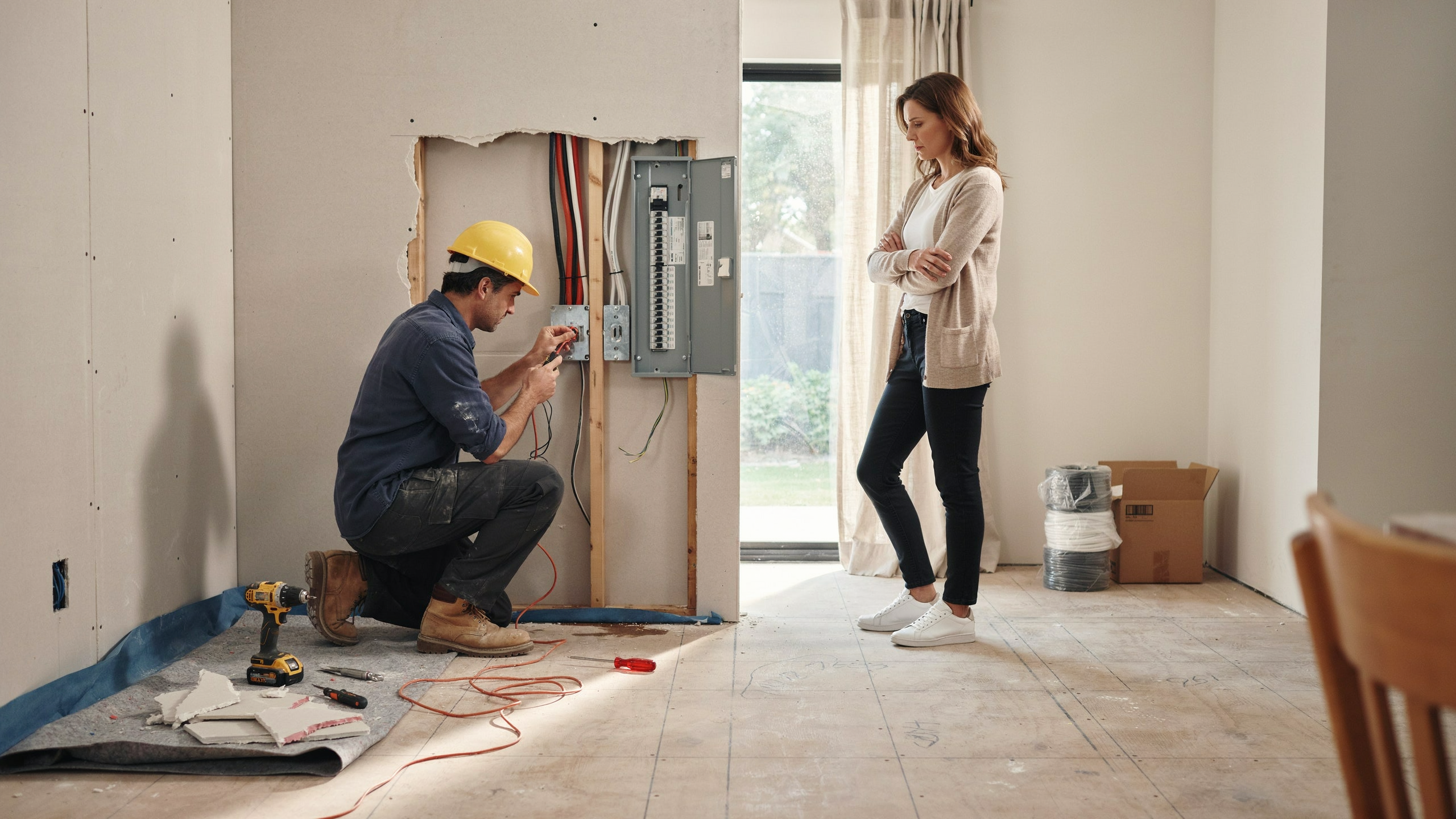
You call an electrician because your breaker keeps tripping or your insurance company flagged your panel as outdated. It seems like a single, contained job. Then the electrician opens the wall, and the project you thought you understood starts pulling in directions you didn’t expect, revealing problems that were sitting there for quite some time.
The First Discovery
Imagine you budget $4,000 and one week for a panel upgrade. After your electrician opens the wall, they find deteriorated wiring near old insulation, which pushes the job into testing, abatement planning, drywall repair and HVAC rebalancing.
The project stretches toward three weeks, adds $6,000 to $9,000 and fills a 10-yard dumpster with torn-out drywall, insulation, wiring and related debris. Once a wall is open, an electrician sees more than the wiring they came for.
Older homes often carry knob-and-tube wiring from decades past, which is considered outdated and may require replacement. This also often means that insurers are less likely to cover these systems.
The Initial Diagnosis
Deteriorating insulation on old wiring sits behind walls, increasing your risk every year it goes untouched. Electrical failures remain a major risk, causing an estimated average of 527 civilian deaths every year. Having a qualified electrician handle your wiring is a key mitigating factor.
An experienced electrician who finds outdated wiring behind your wall rarely just patches around it and moves on. Once it’s visible, flagging it becomes their professional obligation, and often their legal one too.
Many of these warning signs show up long before opening a wall. Flickering lights, warm outlet covers and breakers tripping for no clear reason are signs your home needs an upgrade.
Identifying these factors before a contractor points them out gives you a chance to plan ahead on your own terms, instead of discovering them mid-project when you have far less control over the schedule and the budget.
When Insulation Becomes a Problem
Opening a wall for electrical work often means disturbing insulation that has sat for decades, where the next surprise tends to show up. Older homes sometimes contain vermiculite insulation that may be contaminated with asbestos. This mineral fiber poses a health risk when it becomes airborne.
If your contractor suspects this material is behind your walls or in your attic, work must stop until it’s tested. If asbestos is confirmed, only a licensed abatement professional can remove it safely. That single discovery can add extra time to a project, along with a cost that was nowhere on your original estimate.
The HVAC and Code Domino
Electrical and insulation work rarely stays contained to a single wall cavity. Once your walls are open and your insulation has been removed or disturbed, replacing it with modern insulation often changes the room’s thermal performance enough that your existing HVAC system no longer balances it properly. In some cases, an undersized, aging or poorly routed system may need duct changes, equipment replacement or a new ventilation plan.
Building codes can further complicate this, as permitted electrical work may require additional updates beyond the original repair, depending on your local rules and the scope of the project. That single requirement is often the point at which a homeowner realizes that electrical upgrades can become whole-room renovations, complete with new drywall and updated ventilation.
Rooms that get reinsulated but not rebalanced can end up running their heating and cooling harder than before, adding to your utility bill on top of the renovation cost itself. At this point, your contractor’s crew is now on-site far longer than anyone planned.
Adding in the Cost of Waste
Every one of these cascading fixes generates physical debris, and it adds up fast. Old wiring, damaged insulation and outdated ductwork all become demolition waste headed for a dumpster.
Construction and demolition activity across the country generated roughly 600 million tons of debris in 2020 alone. Residential renovation is one of the categories that feeds directly into that total.
A project that started as a single panel swap can easily fill more than one dumpster once insulation and old wiring are stripped out and hauled away. Setting up a centralized station for sorting recyclables on the jobsite, rather than tossing everything into one pile, is a great DIY way to manage waste more intuitively.
Why Contractors Don’t Always Warn You
An electrician’s quote for your job is often scoped narrowly, focusing on wiring and panels rather than on insulation or HVAC systems that fall outside their trade. It isn’t always a lack of honesty that keeps contractors from mentioning these cascades up-front.
They may genuinely not know what’s behind your walls until they open them. Flagging every hypothetical issue on every job would make estimates so padded that few homeowners would ever move forward. The discrepancy between what a contractor can reasonably promise and what a 50-year-old wall might actually contain is where most of this frustration lives, and it’s rarely anyone’s fault so much as the nature of working on a house you can’t fully see into until it’s already open.
Planning for the Whole Project
An outdated panel is a real risk, and putting off the work rarely makes the eventual project smaller. What helps is going in with realistic expectations instead. Ask your contractor directly what they expect to find once the wall is opened, and what will happen to your project timeline and budget if they find it. Get that answer in writing before the first wall comes down. Keeping your eyes open will make the ripple effects far easier to plan around and live with.
