

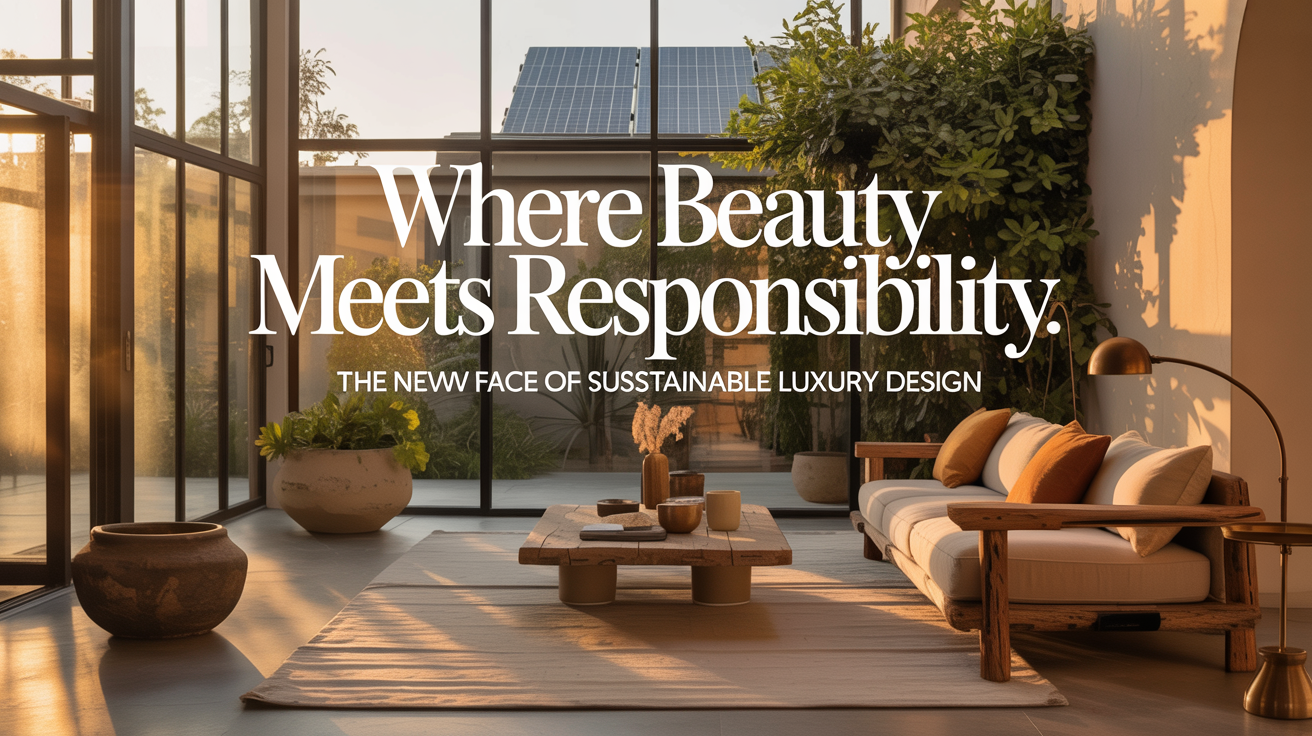
Redefining What Luxury Means
For decades, luxury in the built environment was measured in superlatives — the rarest materials, the most expansive square footage, the most energy-intensive systems. A grand home was one that announced its opulence freely, regardless of what that announcement cost. But something has shifted. Today’s most discerning clients, architects, and designers are rewriting the definition of luxury — and sustainability has moved from afterthought to cornerstone.
The new luxury isn’t about excess. It’s about refinement. And in that context, a home that treads lightly on the planet while delivering extraordinary comfort, beauty, and performance is the ultimate expression of sophisticated design.
The Myth That Sustainability Means Compromise
One of the most persistent misconceptions in residential design is that sustainable choices require aesthetic sacrifice. The reality is precisely the opposite. The materials, technologies, and design philosophies that characterize truly sustainable luxury homes are, by nature, exceptional — because they are chosen with intention, precision, and a deep understanding of long-term performance.
Consider the material palette of a sustainably designed luxury home. Reclaimed antique oak flooring carries the patina of centuries and the story of its provenance — a character no new-milled board can replicate. Handmade terracotta tiles, fired with lower-carbon techniques, bring warmth and texture that mass-produced alternatives simply cannot match. Stone sourced from regional quarries arrives with both lower transportation emissions and a connection to local landscape that lends a property a genuine sense of place.
These are not compromises. They are upgrades in quality, in character, and in the meaning they bring to a space.
Architecture That Works With Nature
The most celebrated sustainable luxury homes are distinguished by architecture that is fundamentally responsive to its environment, whether through a new renovation or new build. Passive design principles, orientation toward optimal solar angles, strategic placement of overhangs to manage seasonal sun, cross-ventilation pathways that reduce mechanical cooling loads, are not constraints on design. They are the intelligence that shapes it.
Homes designed to breathe with their climate, rather than fight against it, achieve something rare: they feel different from the moment you enter. The quality of light is better, carefully considered apertures capturing the arc of the sun through the day. The air is fresher, natural ventilation carrying the scent of the surrounding landscape. The temperature is more even — thermal mass in floors and walls moderating the swings that mechanical systems struggle to address.
Landscape integration plays an equally important role. Native plantings, living walls, green roofs, and water-responsive gardens don’t just reduce resource consumption — they blur the line between interior and exterior in ways that elevate the experience of a property profoundly. A reflecting pool that also serves as a greywater system. A planted roof that provides insulation and becomes a private garden. These are the kinds of design moves that distinguish extraordinary from merely expensive.
Smart Technology as the Invisible Infrastructure
Behind the walls of the finest sustainable luxury homes lies a sophisticated network of systems that most occupants will never directly see. Building automation platforms that learn from occupancy patterns and adjust lighting, climate, and energy use accordingly. High-efficiency heat pump systems that replace conventional HVAC with quieter, more precise, and dramatically lower-carbon alternatives. Solar arrays — increasingly integrated directly into roofing materials as building-integrated photovoltaics — that generate energy without any visual intrusion on the architectural form.
Battery storage systems have transformed the energy independence available to high-performance homes. A luxury property equipped with a well-designed solar and storage system can operate entirely independently of the grid for extended periods — a level of resilience that appeals powerfully to buyers who expect their homes to perform as impeccably as every other aspect of their lives.
Andrew Hoesly, General Manager at SolarTech, speaks directly to the expectation shift he sees in the luxury segment. “Energy efficiency in luxury homes is no longer just about reducing bills, it’s about the standard of living the home delivers,” Hoesly said. “Our highest-end clients want a home that is quietly, invisibly intelligent about energy. They want comfort, consistency, and independence. The technology exists to deliver all of that while creating something genuinely beautiful, and that intersection of performance and design is where the most exciting work in residential energy is happening right now.”
Certifications as a Signal of Intent
A growing number of luxury buyers and developers are pursuing formal green building certifications — LEED Platinum, Living Building Challenge, Passive House — not as marketing tools, but as a disciplined framework for delivering on sustainability commitments. These programs set rigorous standards for energy performance, water use, material health, and occupant experience.
Far from constraining the design process, the most sophisticated designers and architects report that working within these frameworks pushes creativity and problem-solving in productive directions. Constraints breed ingenuity. The homes that emerge from a genuinely performance-driven process are often more inventive, more thoughtful, and more beautiful than those designed without such accountability.
The Legacy Value of a Responsible Home
There is one more dimension of luxury sustainability that is increasingly discussed among high-net-worth buyers: legacy. A home that is built with care for its environmental impact, designed to last for generations, and equipped with systems that will continue to perform well as energy markets evolve is not just a better investment — it is a more considered one.
Buyers who think in decades rather than years understand that a home’s relationship to energy, water, and materials is part of its fundamental character. In that frame, sustainability is not a feature. It is a philosophy; one that produces homes of enduring beauty, genuine intelligence, and quiet, uncompromising excellence.
That is, by any measure, the definition of luxury.
