


Your tap water travels through miles of aging infrastructure before reaching your glass. Along the way, it can capture contaminants ranging from lead and chlorine to emerging threats like per- and polyfluoroalkyl substances (PFAS).
The most effective water filters do more than improve taste. Through verified, third-party testing, they remove specific health hazards. NSF International (NSF/ANSI) certification, in particular, proves a filter actually does what it claims.
This guide ranks the top water filtration systems based on contaminant removal performance, certification standards and long-term value to help you choose the best protection for your home.
1. Multipure

With its unique solid carbon block technology that functions as three filters in one, Multipure earns the top spot. Its approach allows it to achieve NSF/ANSI certification for removing a wider range of contaminants than most competitors. By targeting lead, perfluorooctanoic acid (PFOA) and perfluorooctane sulfonate (PFOS) and cysts while preserving beneficial minerals for your body, the Aquaperform system demonstrates optimal effectiveness.
The lifetime warranty on housing and 90-day money-back guarantee prove the company stands behind its craftsmanship. Additionally, when you sign up for the Filter Autoship Subscription Program, you can save 15% on replacement filters. This combination of proven performance and long-term value makes Multipure the most reliable investment for health-conscious homeowners.
Key Features
- NSF/ANSI certified to reduce lead, PFOA/PFOS and cysts
- Solid carbon block acts as three filters in one
- Lifetime warranty on housing with a 90-day satisfaction guarantee
- 15% savings available through the Filter Autoship Subscription Program
2. Aquasana

Aquasana is the ideal solution if you want to filter water throughout your entire house. The OptimH2O system underwent International Association of Plumbing and Mechanical Officials (IAPMO) testing under NSF/ANSI Standard 53, demonstrating that it removes up to 99% of lead and cysts and up to 98% of PFOA/PFOS.
Independent testing under NSF/ANSI Standard 42 confirms it eliminates as much as 90% of chlorine and chloramines. Through rigorous third-party certification from NSF and the Water Quality Association, these Aquasana whole-house filters deliver filtered water to every faucet, shower and appliance in your home. Whether you drink, cook or bathe, the comprehensive approach protects your family from contaminants.
Key Features
- IAPMO tested to remove up to 99% of lead and cysts
- Removes up to 98% of PFOA/PFOS
- Eliminates up to 90% of chlorine and chloramines
- Whole-house coverage for every water source
3. Waterdrop

For people new to water filtration or working within a tight budget, Waterdrop offers an accessible entry point. The brand focuses on pitcher and faucet-mount options that require no professional installation. Using six-stage reverse osmosis (RO) filtration, the Waterdrop C1S Countertop CoreRO System reduces total dissolved solids (TDS), PFOA, chlorine, lead and additional contaminants.
One satisfied customer notes that the system delivers “fantastic quality, taste and space savings” compared to their previous filter. Without the commitment of a permanent under-sink installation, these Waterdrop filter options provide solid performance. Renters and homeowners who prefer flexibility will especially find the countertop design ideal.
Key Features
- Six-Stage RO filtration reduces TDS, PFOA, chlorine and lead
- Countertop design requires no permanent installation
- Budget-friendly pricing for entry-level filtration
- Space-saving compact footprint
4. APEC

For homeowners seeking RO technology, APEC is the top choice. Its products offer a different filtration approach that removes nearly all dissolved solids from water. Providing 1,000 gallons per day (GPD) of clean drinking water for the whole family, the APEC ROTL-A1000ALK tankless system delivers consistent performance.
This RO water filter removes up to 99% of over 1,000 impurities. With third-party certification to NSF 372 and 58 standards, it meets rigorous safety requirements.
The tankless design also saves space under your sink while delivering consistent flow rates. In areas with hard water or high mineral content, APEC systems work especially well.
Key Features
- Removes up to 99% of over 1,000 contaminants
- NSF 372 and 58 certified for safety and performance
- Tankless design provides 1,000 GPD capacity
- Ideal for hard water and high mineral content areas
5. Cloud Water Filters
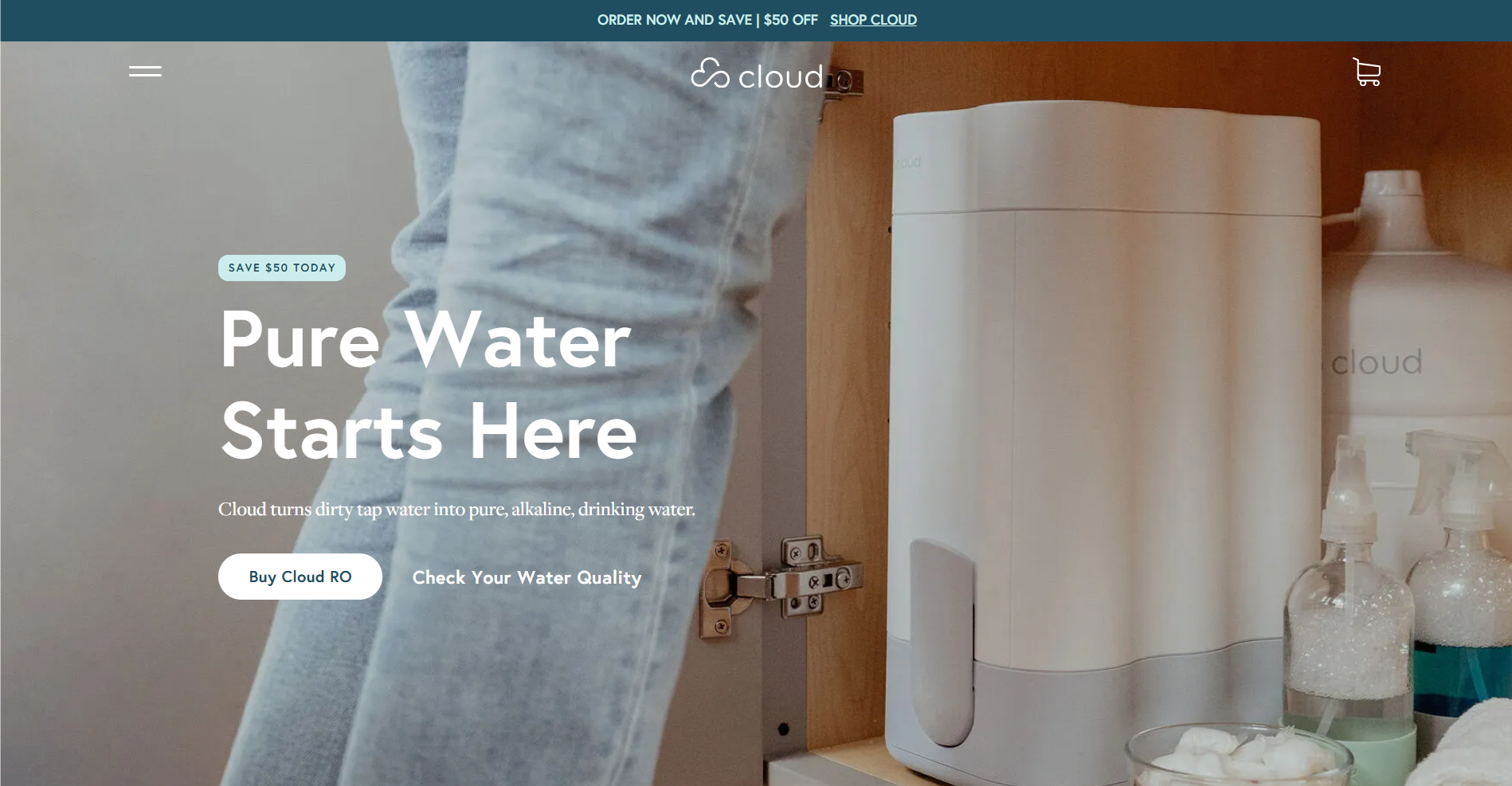
Cloud Water Filters stands out for eliminating the need for complex plumbing modifications. For renters or those who want powerful filtration without a permanent installation, this is the perfect choice.
Removing 99% of toxins in tap water, including PFAS, heavy metals, microplastics, fluoride and other threats, the Cloud RO under-sink system provides comprehensive protection.
By connecting to the Cloud app, you can monitor your water quality in real time. The technology gives you visibility into what you are removing from your drinking water. For modern households, Cloud combines convenience with comprehensive contamination reduction.
Key Features
- No plumbing required for easy installation
- Removes 99% of PFAS, heavy metals, microplastics and fluoride
- Real-time water quality monitoring through a mobile app
- Ideal for renters and temporary living situations
6. iSpring

iSpring provides robust filtration designed for homes with well water that often contains sediments and microorganisms. Reliable filtration for these systems is crucial since well water requires more intensive treatment than municipal water.
One five-star reviewer chose this manufacturer after comparing several options. They most appreciated the six-stage RO system along with “reasonably priced” replacement filter kits, noting that “the water from the new system has a nice taste” after installation.
Over time, filter kits make maintenance straightforward and cost-effective. By addressing the complex contamination profile typical of well water sources, the six-stage process delivers the thorough filtration well owners need.
Key Features
- Six-stage RO system for comprehensive well water treatment
- Affordable replacement filter kits readily available
- Effective removal of sediments and microorganisms
- Proven performance with strong customer satisfaction ratings
7. Hydroviv

By creating filters customized to your specific local water quality data, Hydroviv takes a unique approach. The team reviews water quality databases at the local, county, state and federal levels to determine which contaminants are present in your drinking water. With this personalized strategy, your filter targets the threats that actually affect your household.
Founder Dr. Eric Roy explains that “Hydroviv exists to help people cut through the scientific jargon so they can better understand their water, and to help them lower their risk and protect their families.”
This customized approach works best for households with known local water quality concerns. The personalized filtration addresses your specific contamination profile rather than generic threats. Likewise, its subscription service sends a new filter every six months and offers 25% off replacement cartridges.
Key Features
- Customized filters based on your local water quality data
- Reviews local, county, state and federal water databases
- 25% savings on replacement cartridges through subscription
- Personalized contamination targeting for your specific location
Comparing the Top Water Filters
Each filtration system serves different household needs and budget requirements. This comparison table breaks down the key specifications to help you evaluate which option matches your priorities.
| Company | Filter Type | Key Contaminants Removed | NSF Certifications | Subscriptions |
| Multipure | Solid carbon block | Lead, PFOA/PFOs and cysts | NSF certified | 15% discount available |
| Aquasana | Whole house | Lead, cysts, PFOA/PFOS, chlorine and chloramines | NSF/ANSI 53 and 42 (IAPMO tested) | Available |
| Waterdrop | Six-Stage RO | TDS, PFOA, chlorine and lead | NSF/ANSI 58, 42, 53 and 401 | Available |
| APEC | Reverse osmosis | Over 1,000 impurities | NSF/ANSI 372 and 58 | Available |
| Cloud Water Filters | Reverse osmosis | PFAS, heavy metals, microplastics and fluoride | NSF/ANSI 58 | Available |
| iSpring | Six-Stage RO | Sediments, microorganisms and general contaminants | NSF/ANSI 58 | Available |
| Hydroviv | Customized carbon | Location-specific contaminants | NSF/ANSI standards 42 and 53 (IAPMO tested) and NSF/ANSI/CAN 372 | 25% discount |
Evaluation Factors for Selecting Water Filters
This ranking evaluates water filtration systems based on four primary criteria. Measurable contaminant removal backed by independent testing serves as the foundation for effectiveness. NSF/ANSI certification provides the most reliable proof that a system performs as claimed, so filters with verified performance data earned priority over those that rely solely on marketing promises.
Long-term value matters as much as initial cost when protecting your family’s health. Ease of use and installation accessibility determine whether you will actually maintain the system properly. Combined, these factors identify the water filters that deliver consistent protection over years of use.
A Buyer’s Guide to Choosing the Right Water Filtration System
The best filter for your home depends on your specific water quality and household needs. By understanding what contaminants exist in your local supply, you can choose the right technology. Before making your purchase, this section outlines the key factors to consider.
Understanding Your Local Water Quality
The effectiveness of any filter depends on matching its capabilities to your actual contamination risks. Municipal water reports reveal what is already in your tap water before filtration. You can search your local waterway quality for drinking water or other uses to identify specific threats.
Some areas struggle with lead from aging pipes, while others face agricultural runoff or industrial chemicals. Through your local water quality report, you can see exactly which contaminants exceed safe levels. With this information, you can then choose filters certified to remove your specific threats rather than generic models.
What are NSF ANSI Certifications
NSF certifications provide independent verification that a filter actually removes what it claims. Since no federal regulations exist for residential water treatment filters, purifiers and reverse osmosis systems, these standards are voluntary. By understanding the different criteria, you can evaluate product claims more effectively.
NSF/ANSI 42 addresses taste, smell and chlorine. These filters remove aesthetic impurities like chlorine but do not necessarily protect against health hazards. NSF/ANSI 53 covers health effects, including lead, cysts and other dangerous contaminants.
NSF/ANSI 401 focuses on emerging contaminants, such as pharmaceuticals and PFAS. Look for multiple certifications if your water contains various threat types. Filters certified under Standard 53 provide greater health protection than those certified under Standard 42.
Key Filter Technologies Explained
Different filtration technologies excel at removing specific contaminant types. Solid carbon block filters physically trap particles and absorb chemicals through activated carbon. This dual-action approach makes them effective against both particulates and dissolved contaminants. Studies even show that activated carbon removes over 90% of critical contaminants, including chlorine, pesticides and volatile organic compounds.
Reverse osmosis systems work differently, pushing water through a thin membrane that blocks nearly everything except water molecules. This method excels at removing dissolved minerals, salts and emerging contaminants like PFAS.
Likewise, ion-exchange resins swap harmful ions, such as lead, for harmless ions, like sodium. Each technology has strengths and limitations. Many effective systems combine multiple technologies to address broader contamination profiles.
Evaluating Contaminant Removal Performance
Filter performance directly impacts your long-term health outcomes. PFAS exposure creates serious health risks that effective filtration can prevent. Studies link PFAS to a risk of higher cholesterol levels, kidney and testicular cancer, smaller birthweight and greater risks for pregnancy-induced hypertension and preeclampsia.
Risks often depend on exposure levels, individual factors and other health determinants. This makes prevention through effective filtration more practical than managing health consequences later. Look for specific removal percentage claims backed by independent testing rather than vague “reduces contaminants” language.
Third-party certification proves that a filter removes specific percentages of targeted contaminants. Higher removal percentages provide better protection when contamination levels fluctuate and give you confidence that your investment actually protects your family.
Calculating Long-Term Costs
Initial purchase price tells only part of the financial story. Replacement filter expenses and frequency determine the true cost of ownership. Some budget-friendly water filters require pricey cartridge replacements every few months, while premium systems use longer-lasting filters.
Calculate annual filter costs by dividing the cartridge price by the number of months of use and multiplying by 12. Subscription plans often provide discounts on replacement filters while ensuring you never forget to change them, conveniently helping you maintain consistent protection.
Additionally, you should consider installation costs if professional plumbing is required. Systems with a simple do-it-yourself setup save money up-front and during maintenance. The most cost-effective filter balances initial price, replacement costs and lifespan to deliver the lowest per-gallon cost over years of use.
The Best Choice for Your Health
Effective water filtration requires proven performance, as demonstrated by independent certification rather than marketing claims. The systems ranked here demonstrate verified contaminant removal backed by NSF testing and real customer results. Investing in certified filtration protects your family from health risks linked to contaminated drinking water.
Frequently Asked Questions
How often do you need to change your water filter?
Replacement frequency varies by filter type and water quality. Most carbon filters last three to six months, while RO membranes can function for two to three years. Always check your manufacturer’s guidelines and replace filters when the flow rate decreases noticeably.
Do water filters remove fluoride?
According to studies, most at-home carbon filters do not remove fluoride from drinking water. RO systems and activated alumina filters reduce fluoride levels, whereas standard carbon filters do not. Check certification documents to confirm fluoride removal if this matters to your household.
Can you install a water filter yourself?
Many countertop and faucet-mount filters require no tools or plumbing knowledge, but under-sink systems vary in complexity. Some models use push-fit connectors for simple DIY installation, while others benefit from professional plumbing. Review the installation requirements before purchasing to ensure they match your comfort level.
