

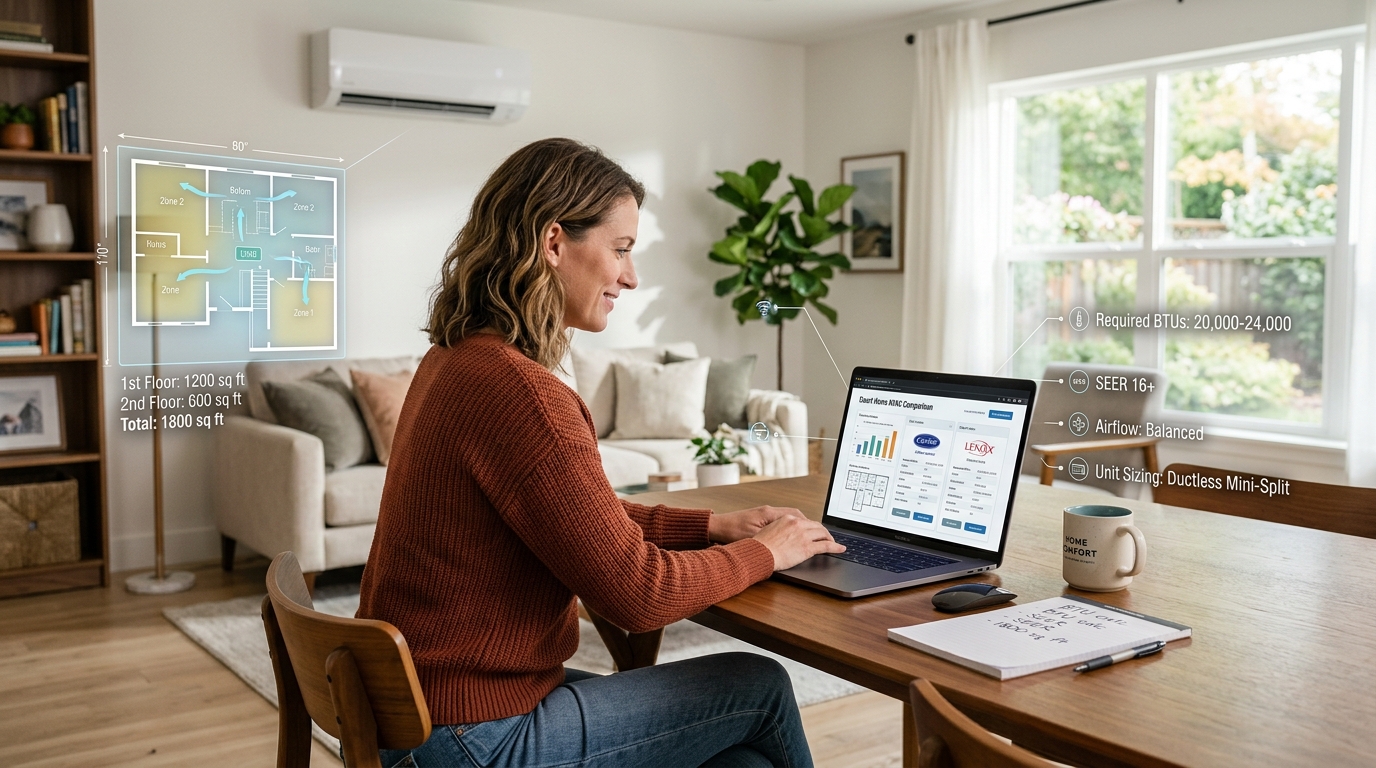
When you buy HVAC equipment online, you skip one of the most valuable parts of the traditional purchasing process: the in-home estimate. A contractor walking through your home can spot insulation gaps, measure window orientations, and calculate exactly how much heating and cooling capacity you need. Without that visit, the responsibility for sizing falls on you. Get it right, and your system will run efficiently for fifteen to twenty years. Get it wrong, and you will fight humidity issues, hot spots, short cycling, and premature equipment failure for as long as you own the unit.
The good news is that you can size an HVAC system accurately from your kitchen table if you understand the underlying logic and use the right tools. Here is how to do it.
Why Sizing Matters More Than You Think
HVAC sizing is measured in tons for cooling and BTUs per hour for heating. One ton equals 12,000 BTUs of cooling capacity. Most residential systems range from 1.5 to 5 tons, and the temptation when buying online is to round up "just to be safe." This is the single most common mistake homeowners make.
An oversized air conditioner cools the air quickly but shuts off before it has time to remove humidity. The result is a cold, clammy house that never feels comfortable. The compressor cycles on and off constantly, which wastes electricity and shortens the equipment's lifespan dramatically. Oversized furnaces produce similar problems, blasting hot air in short bursts that leave rooms unevenly heated and increase wear on every component.
An undersized system has the opposite problem, running continuously without ever reaching the target temperature on the hottest or coldest days of the year. Correctly sized equipment hits a sweet spot where runtime is long enough to remove humidity and distribute air evenly, but not so long that the system can never catch up.
The Square Footage Rule of Thumb (And Why It Falls Short)
You will see online sources suggesting one ton of cooling for every 400 to 600 square feet. This rule has survived because it is easy to remember, but it produces unreliable results. A 2,000 square foot home in Phoenix needs significantly more cooling than the same square footage in Seattle. A house with vaulted ceilings, single-pane windows, and poor insulation needs more capacity than a tightly built modern home of identical size.
Use the square footage rule only as a sanity check. If your detailed calculation produces a wildly different answer, recheck your work. But never use it as your sole basis for buying equipment.
Manual J: The Industry Standard
The proper way to size an HVAC system is a calculation called Manual J, developed by the Air Conditioning Contractors of America. Manual J accounts for every variable that affects heating and cooling load: square footage, ceiling height, window area and orientation, insulation R-values, air infiltration rates, occupant count, appliance heat output, and local climate data.
You have three realistic options for getting a Manual J calculation done.
First, you can hire an independent energy auditor or third-party service to perform one for $150 to $400. This is the most accurate approach and produces a documented report you can use to confirm equipment sizing.
Second, you can use online Manual J software designed for homeowners. Tools like CoolCalc offer free or low-cost versions that walk you through the inputs systematically. Plan on spending two to four hours gathering measurements and entering data, but the result is a credible load calculation.
Third, some online HVAC retailers offer free sizing assistance as part of the purchase process. Quality varies widely. The best ones ask detailed questions about your home; the worst ones plug your zip code and square footage into a generic formula. Treat retailer sizing as a starting point, not a final answer.
Gathering the Information You Need
Before running any calculation, collect the following information about your home.
Measure the conditioned square footage of every room you want heated and cooled. Do not include garages or unconditioned basements. Note the ceiling height in each space, since vaulted areas hold more air volume.
Document every window: dimensions, glazing type, and the direction it faces. South and west-facing windows admit substantially more solar heat in summer. Identify the type and condition of insulation in your walls, attic, and floors. If you do not know the R-values, estimate based on the age of your home and any upgrades you are aware of.
Note the construction type, framing materials, and the tightness of the building envelope. Newer homes built after 2010 are typically much tighter than older construction. Record your zip code, which determines the design temperatures used for both heating and cooling calculations.
Climate Considerations
Your climate zone shapes the entire sizing calculation. The Department of Energy divides the country into eight climate zones, and HVAC requirements differ substantially among them. A heating-dominated climate like Minnesota prioritizes furnace or heat pump heating capacity, while a cooling-dominated climate like Florida prioritizes air conditioner tonnage and humidity control.
If you live in a humid climate, slightly undersizing the cooling capacity often produces better comfort than perfect sizing, because longer runtimes remove more moisture. If you live in a dry climate, this concern matters less and you can size closer to the calculated load.
Matching Heating and Cooling for Heat Pumps
Heat pump sizing requires extra care because the same unit handles both heating and cooling, and the optimal size for each function may differ. In moderate climates, sizing for cooling load typically works well, with electric resistance backup or a dual-fuel furnace handling extreme cold. In colder climates, cold-climate heat pumps with enhanced heating capacity allow you to size more aggressively for heating without sacrificing summer performance.
Look at the heat pump's performance data at low outdoor temperatures, often labeled as capacity at 17 degrees Fahrenheit or 5 degrees Fahrenheit. A heat pump rated for three tons of cooling may deliver only two tons of heating capacity at 17 degrees, which matters enormously in cold climates.
Sanity Checking Before You Buy
Once you have a calculated load, run a few sanity checks before placing your order. Compare the result to the rule of thumb to confirm you are in a reasonable range. Compare it to the size of your existing equipment, accounting for any insulation or window upgrades you have made. Ask a contractor for a second opinion, even if you do not plan to hire them for installation.
Sizing is not glamorous work, but it determines whether your decision to buy HVAC equipment online ends in years of comfortable, efficient operation or in expensive frustration. Take the time to do it carefully, and the equipment will reward you for as long as you own it.
