

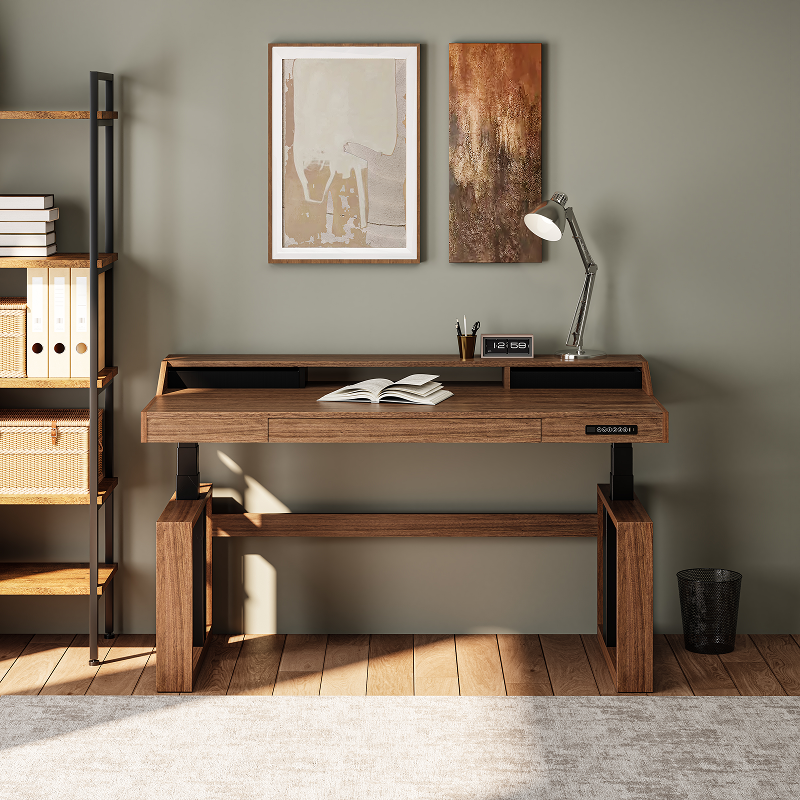
To most people, the phrase “executive desk” probably brings to mind an image of a bank manager in 1985. At home, though, an executive desk means something a little different: a desk that is bigger than the sad flat-pack special you bought on Saturday because you needed something by Monday, has room to put some things away, and doesn’t make you wince every time you look at it.
Most people aren’t even thinking about executive desks until working from home stops being a side option. And your options for an executive desk for home office use are currently divided between two main categories: traditional wooden desks at standard height, and standing desks built to a similar standard.
Measure the Room to Start With
A showroom will make a six-foot desk look like it would fit anywhere. Remember to measure the spare bedroom you’ve been eyeing for your home office before you buy. When measuring, allow room to actually use the desk. You need to be able to pull your chair out from under it to stand, and (just as importantly) the drawers need to open without hitting your knees or the radiator. Five-foot desks are common enough in both categories and should be plenty big enough to fit your monitor, laptop, and a couple of notebooks.
Storage on a Standing Desk
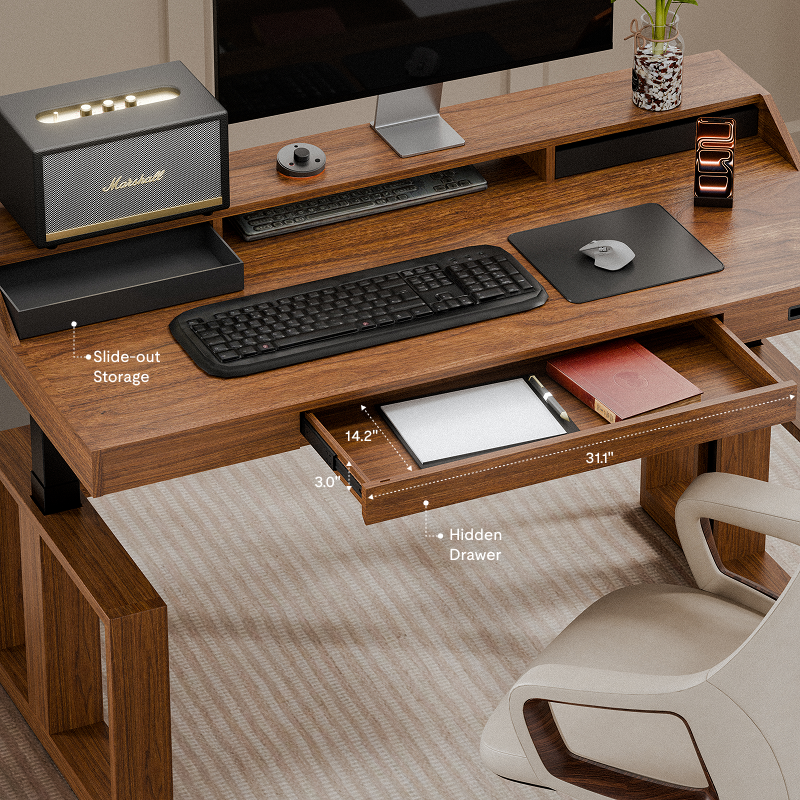
Storage was always the strong suit of traditional desks. Even a modest traditional desk has at least one drawer to hide the cords and odds and ends that litter the desktop.
Standing desks didn’t always have that option. Frequently, you had just a frame, a desktop, and a motor.
A standing desk with drawers makes up for that by putting the drawers in the desktop. The drawer moves up and down with the desktop, so whatever you need to reach for while standing is right there at hand.
A couple of manufacturers offer a variation with a shelf along the back of the desk, to hold your monitor at a more comfortable height, and provide some storage space underneath for a notebook or hard drives. You’re not going to be able to file things in these, and if you work with paper, you’ll want a cabinet anyway. But a standing desk with a drawer or two often has plenty of room to keep a small desk from getting cluttered.
Height
Most standard desks are roughly the same height: thirty inches or so from the floor to the desktop. That works for people of average height, but if you’re above or below average, you can expect to hunch over a keyboard or type with your feet barely touching the floor.
A standing desk lets you set the desk to your own height, but I think the value is in being able to change it throughout the day. You can stand while you talk on the phone, sit while you write, and stand for a while when your back starts to stiffen up in the afternoon.
Note the lowest and highest settings when you are considering a desk. A short person needs the desk to go low enough to let them sit comfortably, and a tall person needs it to rise high enough that they can work while standing without rounding their backs.
Can a Standing Desk Look Like Furniture?
Until recently, not always. Many standing desks had steel legs, a bare laminate top, and a tangle of cables at the back. They looked like something bought from the IT department.
If you want a modern home office desk, look for models with legs made of wood or otherwise disguised. FlexiSpot’s Fusion Retro model uses rectangular walnut-colored frames for each leg to disguise the lifting columns and create a warmer look. Combined with the slim drawer and the shelf at the back, it makes the desk look more like a piece of mid-century furniture than a piece of office equipment.
I’m still not sure which type of desk I prefer, myself. Real wood has a warmth that a typical standing desk doesn’t have, and if looks are important to you, a traditional desk might still be the way to go. But I think most people trying to furnish a home office would find the difference between the two types less important than the other considerations.
Budget
Most traditional desks are a balance between how much you want to spend and how long you want the desk to last. Particle board with veneer is lightweight and looks good enough for a few years, while real wood costs more and lasts far longer.
With a standing desk, most of the budget goes into the mechanics that raise and lower it. Look for desks with dual motors in the frame, on either side of the desktop. They help the desk lift more weight evenly, and a solid frame keeps the desktop from swaying too much when you’re standing and typing. Read the fine print on the motor warranty to see how long the manufacturer is willing to stand behind the mechanics.
Which Desk Is Best for You?
If you work at home only a day or two per week, or if you’ve found an excellent traditional desk that you want to keep for twenty years, a traditional desk makes as much sense for you as a standing one.
If you work at the desk for long hours, or share it with somebody else of a different height, a standing desk is probably a better value.
If you want a desk that looks nice but still has a place to put your things, and you don’t want to be at one height all the time, the standing desk with drawers is right in the middle. It would be my recommendation for a primary home office desk.
FAQ
Can a Standing Desk Support a Full Home Office Setup?
A good-quality one can, but make sure to check the weight rating and leave a little room to spare. After all, monitors, computers, and books all add up.
How Much Room Do I Need for an Executive Desk?
More room than the desk itself takes up. It’s a good idea to sketch out the room on paper and mark the desk, the chair, and the door swings, so that you can see potential problems before the desk arrives.
