

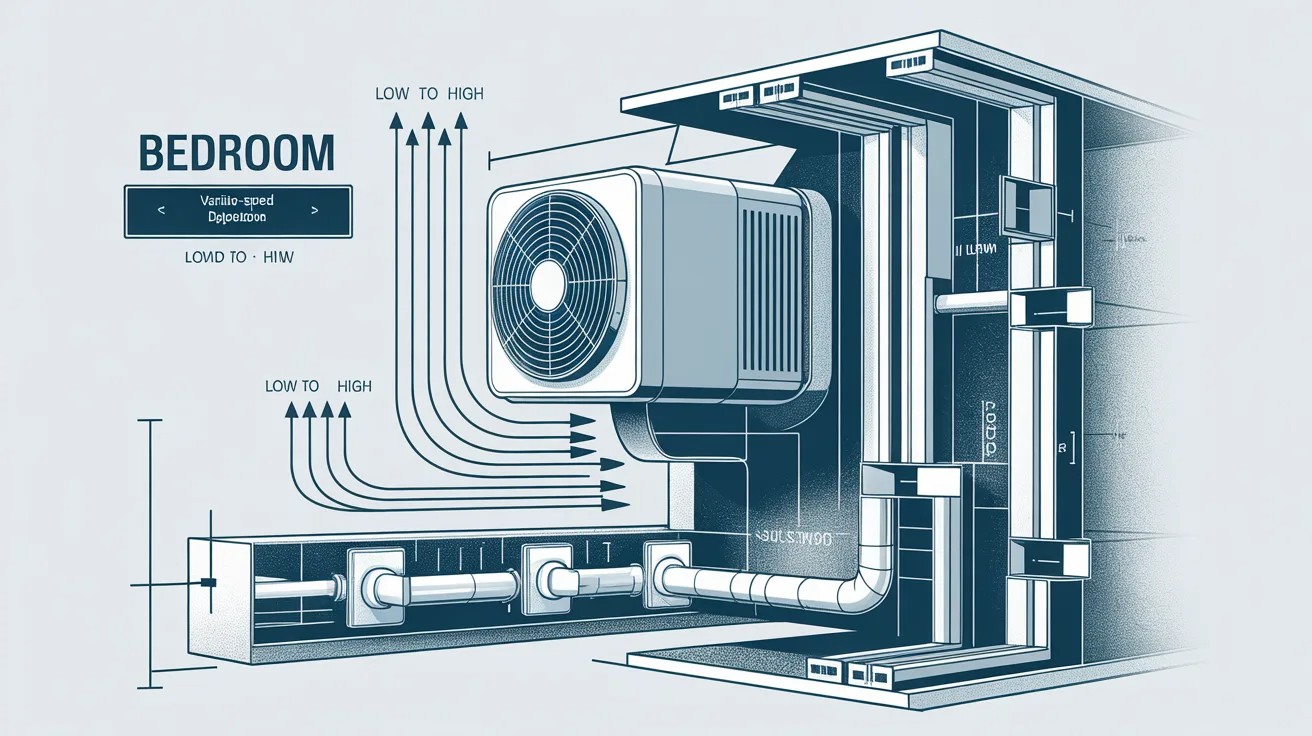
It’s easy to see airflow problems in bedrooms because, as you’d expect, noise and air movement are more noticeable when you’re trying to sleep. A variable-speed blower will help with this problem by moving air more smoothly, but simply setting it to a low speed won’t make it quieter. You need to think about the blower, ductwork, filter, and registers together. If one of these parts is blocked, the grille can make a whistling, rumbling, or rushing sound. Older duct designs can also send too much air to one side of the house and not enough to the other. This can lead homeowners to close off air vents, raising static pressure. A well-designed system keeps the air moving and the pressure balanced, so the blower can run at lower speeds for longer periods without making noise.
Quiet Airflow Setup Basics
Confirm Equipment and Control Options
First, determine what kind of variable-speed blower you have and how to use it. A variable-speed blower often has an ECM motor that can be programmed to adjust airflow for heating, cooling, and continuous fan operation. The indoor unit may let you choose the airflow through dip switches, jumpers, or a menu on the control board. If you want to select the full range of ramping and dehumidification options, you may need to use a communicating thermostat or a proprietary controller. The nameplate on the indoor unit and the installation instructions should be checked for airflow information. The optimal airflow target depends on the equipment size, the type of coil used, and the duct system layout. If the blower is connected to a furnace, determine whether the system is single-stage or multi-stage. This will affect the blower’s ramp rates and how long it runs at low speed. If it is linked to an air handler and a heat pump, check whether the defrost and auxiliary heat have different airflow rates. In many homes, bedroom airflow is limited by duct limitations rather than the blower. Before changing system settings, you need to find out the total external static pressure at the air handler. This will tell you if the system can run at a lower, quieter level without freezing or overheating the coil.
Set Target Airflow Without Overcooling
When airflow is quiet, the face velocity at bedroom registers is usually lower and changes more slowly. Set a reasonable airflow goal for cooling, and then change it as needed. A typical baseline might be 350 to 450 CFM per ton of cooling capacity, but the right number will depend on duct size, humidity level, and coil configuration. If the system struggles with humidity, a slightly lower airflow rate may improve moisture removal but also increase the risk of coil icing. In the bedrooms, the loudest noise will likely be associated with high static pressure and high velocity at the smaller grilles; thus, the quieter path is to reduce static pressure and improve air distribution rather than simply trying to lower blower speed. Control boards often let you set cooling airflow percentage, constant fan airflow, and fan ramps that start low and increase slowly. If you are managing changes quickly due to comfort complaints, some homeowners schedule Same Day HVAC services in Phoenix to handle the measurement and installation, as improper airflow can cause the equipment to shut down. Once you have determined your initial airflow settings, complete a full cooling cycle, check for changes at the bedroom doors and registers, and then check the supply and return temperatures.
Reduce Static Pressure Before Lowering Speeds
A variable-speed blower will attempt to deliver the programmed amount of air even when the ducts are restrictive. This is why sound reduction begins with reducing total external static pressure. The first place to look is the filter. A dirty filter or one with a MERV rating too high for the ducts will cause a high pressure drop. Choose a filter size based on the equipment and change it based on the dust conditions. The next area to investigate is the return side. Bedrooms may have closed doors at night, and if the return air is small or remote from the bedrooms, it may create a pressure difference that causes air to rush under the door or whistle through gaps. Adding a return air path through a transfer grille or jump duct can alleviate this problem. On the supply side, check that dampers are not partially closed, that the flex duct is not kinked, and that takeoffs are not crushed in the attic insulation. Where a room has a small register on a long run, think about using a larger grille or a second supply. This will reduce velocity while keeping the fan within an efficient range, rather than struggling against the duct.
Use Ramping and Continuous Fan Strategically
The benefit of variable-speed equipment is the ability to blow air gently. Ramping is a feature that regulates the blower’s speed. To provide comfort in the bedroom, a slower ramp in and ramp out can be used to avoid the whoosh of air that wakes people up when a cycle begins. Continuous fan speeds are also important. A low continuous fan speed can be used to keep the air well mixed. But for a constant fan, there must be a balance depending on the humidity levels. In regions with high humidity, operating the fan after a cooling cycle may help re-evaporate water from the coil, thereby increasing the humidity level inside the room. So, there is a short off delay or a special dehumidification mode to handle this situation. If your thermostat has the comfort profile feature, you can adjust the nighttime settings to favor longer, slower airflow cycles rather than rapid temperature changes. Another factor to consider is the fan setting during heating. The furnace heating may be drafty in the bedrooms if the airflow is high while the supply air is still warming up. You can use heating ramp profiles that start with lower airflow and then increase as the heat exchanger reaches a stable condition.
Final Checks
To achieve quiet airflow in the bedroom, you have to coordinate blower speeds with the duct system’s capacity and minimize sources of turbulence. First, evaluate the available control options for the equipment and select the target airflow rate based on the system configuration, not estimates. Before reducing the blower speed, balance the static pressure by selecting the appropriate filters, return air paths, and ducts. To maintain constant temperatures and minimize abrupt increases in sound level, use ramp profiles and low, steady fan speeds. Rather than reducing airflow by closing registers, use branch dampers and grille selection to control airflow.
Additionally, consider acoustic control when sound is transmitted over common ducts. Finally, verify the static pressure constraints and the heating and cooling capacity to ensure that comfort improvements do not compromise reliability. By following these procedures, you can make bedrooms feel more peaceful, reduce airflow noise, and help the system operate more smoothly throughout the night.
