

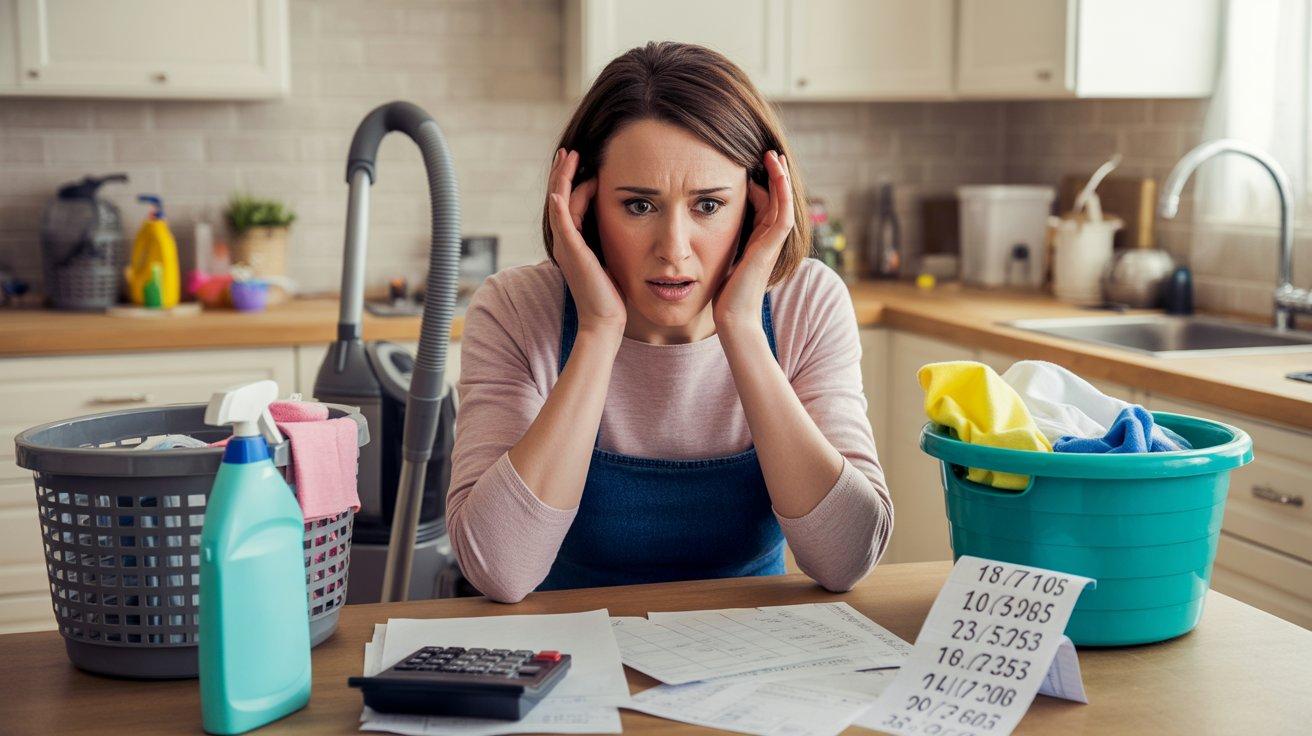
I am going to be honest. I held out on hiring a cleaning service for years longer than I should have, for reasons I now find slightly ridiculous.
Some of it was guilt. The voice in my head — probably my grandmother's — that said cleaning your own house is what adults are supposed to do. Some of it was the cost: paying $180 every two weeks for something I could "just do myself" felt like an indulgence.
And some of it, frankly, was that I had never actually sat down and done the math. Once I did, I felt like an idiot.
How long does cleaning your house actually take?
Be honest with yourself. Not the optimistic estimate. The real one.
A reasonable weekly clean of my three-bedroom townhouse — vacuuming the carpets, mopping the kitchen and bathrooms, scrubbing two showers, wiping down the kitchen, dusting the visible surfaces, changing the sheets on the master bed — takes me, doing it well, about three and a half hours.
Then there is the monthly stuff: baseboards, oven, fridge interior, the inside of the windows. Call it another four hours, spread across the month.
Then the seasonal stuff: blinds, curtains, the dryer vent, behind the stove and fridge. Another six hours per quarter, easy.
Add it up. I was spending somewhere between 18 and 22 hours a month on cleaning. Call it 20.
Twenty hours. Per month. Cleaning.
What is your hour worth?
Here is the calculation that embarrassed me. Take your annual income. Divide by 2,000 (roughly the number of working hours in a year). That is your hourly value, at least in pure economic terms.
I am not going to share my number, but let us say for the sake of argument that you make $90,000 a year. That is $45 per hour.
Twenty hours a month at $45 an hour is $900 of your time. Per month. Spent on a task you do not enjoy and are not particularly good at.
A biweekly cleaning service for the same house? In my zip code, $300 to $400 a month. The math is not even close.
"But you are not actually working in those hours"
I know, I know. The objection is real. You are not literally trading cleaning hours for billable hours. The economic value of your time off is not the same as your work rate.
Fine. Cut my number in half. Twenty hours of leisure time is worth $22.50 an hour to me. That is still $450 a month I am giving up to do my own cleaning. The service is still cheaper. And the result is — I have to admit it — better than what I was producing.
Because here is the other thing nobody told me. Professional cleaners are better at cleaning than I am. This should not be surprising. They do it for a living. They have systems. They have the right equipment. They know which products work on which surfaces. The first time I came home to a house cleaned by professionals, I noticed things being clean that I did not even realize had been dirty.
What I actually do with the time
This was the part that surprised me most. I assumed I would just absorb the recovered hours into the general blur of my week. I would not even notice them.
That is not what happened.
I read more. I cook more. I see friends on Saturdays instead of pushing the vacuum around. I take longer walks with the dog. I have started taking on hobbies again — actual hobbies, not the kind you abandon after three weeks. The mental load of "I should be cleaning" is gone, and it turns out it was taking up more of my brain than I realized.
My therapist, when I mentioned this, laughed and said it was the most common shift she sees in clients who finally hire help. The freed-up cognitive bandwidth is the actual benefit. The clean house is almost a side effect.
The objections I hear from people who have not made the switch
"I would feel guilty having someone else clean my house." Why? You do not feel guilty paying a mechanic to fix your car. You probably do not feel guilty paying someone to cut your hair. Cleaning is a service. The people who provide it have chosen the work, are good at it, and deserve to be paid fairly for it.
"I would have to clean before they came." Look, you would tidy up — put dishes in the sink, pick up clothes off the floor. That is a fifteen-minute task, not a cleaning. There is a difference.
"I cannot afford it." This one I take more seriously. Not everyone can. But a lot of people who say this have not run their actual numbers. They are comparing the cost of the service against zero, when the real comparison is against twenty hours of their own time and the mediocre cleaning result they currently produce.
How to actually pick a service
Once you decide to do it, the next problem is finding someone good. The cleaning industry has a wide range of quality, and the prices do not always reflect it. Some of the cheapest services are excellent. Some of the most expensive are mediocre.
Ask for references from people who have actually used the service for at least six months. Ask whether the same team comes each time (consistency matters more than people realize). Ask what products they use and whether they bring their own equipment. Ask what is included in the regular clean and what costs extra.
I ended up with Pure Homes Cleaning, a professional house cleaning company in Washington, DC, after a friend who is annoyingly particular about her house recommended them. They are not the cheapest option in the city. They are also not close to the most expensive. They are, however, consistently good — and after about a year of biweekly service, I cannot imagine going back. Whatever I was saving by doing it myself, I was not actually saving.
The real lesson
Most of the time, the choices we make by default are not the choices we would make if we actually thought about them. I had been cleaning my own house for years not because I had decided that was the right call, but because I had never decided anything else.
Run the numbers. Make the actual decision. The answer might be that you keep doing it yourself, and that is fine. But at least it will be a real decision instead of a default. That is true of a lot of recurring expenses in adult life, and most of us are quietly losing money to defaults we never examined. Cleaning was just the one I finally caught.
