

Why Brand Choice Actually Matters
Not all standing desks are built by companies that will exist in five years. A 15-year warranty means nothing if the manufacturer closes before your desk needs a replacement part. A 350 lb weight capacity sounds impressive until you discover it refers to a static load — not the actual operating lift capacity under movement.
The best standing desk brands matter because they represent accountability after purchase. Build quality, warranty enforcement, replacement parts, customer support — all of these depend on who made the desk, not just how it looks in a showroom.
61% of office workers report back pain from prolonged sitting, and 52% of corporations have redesigned workspaces to incorporate standing desks as of 2025. The demand is real. So is the volume of brands competing for that spending — which makes informed comparison more important than ever.
How the Standing Desk Market Breaks Down
The standing desk market was valued at $8.7 billion in 2025, projected to reach $14.8 billion by 2035.
Uplift Desk led with over 10% market share in 2025. The top five — Uplift, Vari, Herman Miller, Steelcase, and FlexiSpot — collectively held 30% of the market. The remaining 70% is fragmented across dozens of regional and direct-to-consumer brands.
North America leads adoption at 37% of global market share, followed by Europe at 29% and Asia-Pacific at 22%.
Brands cluster into three strategic tiers:
- Premium corporate: Herman Miller, Steelcase, Humanscale — enterprise wellness programs, premium pricing, longest warranties
- Mid-range performance: Uplift, Fully, Vari, FlexiSpot — best value-to-build ratio, strong direct-to-consumer presence
- Budget and entry-level: Fezibo, VIVO, Autonomous — accessible price points, lighter commercial construction
Best Standing Desk Brands: Tier by Tier
Premium Tier:
Herman Miller launched the Spout Sit-to-Stand Table in February 2025 — featuring four synchronized inline motor actuators and a 400 lb lift capacity. Built for corporate wellness programs. Commands ~11% of the global market. Price range: $1,200–$3,000+.
Steelcase holds approximately 14% global market share — the largest of any single brand. Widely used in enterprise environments. Known for building longevity and compliance with BIFMA commercial standards. Price range: $1,000–$2,500+.
Humanscale focuses on minimal design and passive ergonomic support. Strong presence in architecture and design firms. Price range: $1,500–$3,500.
Mid-Range Performance Tier:
Uplift Desk leads consumer market share at 10%+. Known for one of the widest customization options in the category — surface material, frame color, accessories. Warranty: up to 15 years on frame. Price: $599–$1,200.
Fully (Jarvis) offers sustainable desktop materials including FSC-certified bamboo. Acquired by Herman Miller but maintains independent pricing and positioning. Strong for users who prioritize environmental credentials alongside performance. Price: $499–$800.
FlexiSpot released the E7 Pro 2026 Edition in November 2025 with an upgraded dual-motor system. Motor tested to 30,000+ lift cycles — equivalent to approximately 16 years of daily use at the recommended switching frequency. Price: $350–$700.
Value Tier:
Fezibo and VIVO serve buyers under $300. Single-motor systems adequate for one-monitor home use. Less suitable for commercial environments or heavier equipment loads.
Autonomous launched the SmartDesk 5 in April 2025 with integrated power outlets and a reinforced C-frame rated at approximately 330 lbs. Notable for integrating workspace sensors into the frame — a direction the premium segment is beginning to follow.
What Is an L-Shaped Height Adjustable Executive Desk?
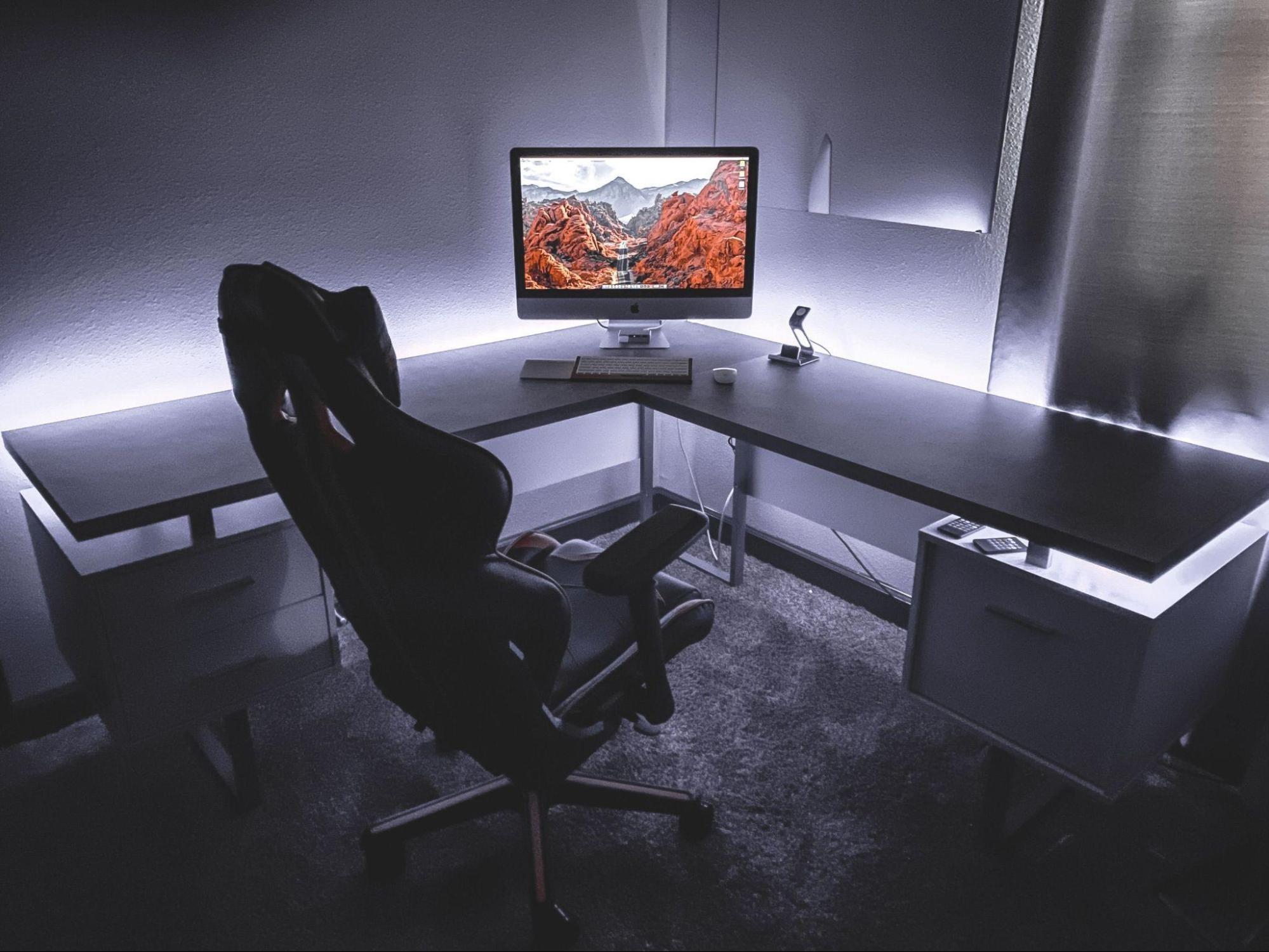
An l-shaped height adjustable executive desk is a corner-format sit-stand desk where the entire surface — both the main section and the return — adjusts simultaneously to the same height via a motorized lift system.
This is distinct from fixed L-shaped desks with a height-adjustable section on one side only. A full-lift L-shaped desk moves the complete working surface together, maintaining ergonomic consistency across the entire workspace at every height.
Standard dimensions run 59–79 inches on the main section and 59–71 inches on the return. Height adjustment ranges typically span 24–49 inches, covering seated to standing positions for most adult users.
Why Executives Are Choosing L-Shaped Sit-Stand Desks
The shift toward L-shaped sit-stand configurations in executive offices isn’t aesthetic. It’s functional.
Surface area: Dual monitors, documents, and a laptop simultaneously — a standard 60-inch straight desk runs out of usable surface quickly. An L-shaped layout provides 40–60% more workspace without increasing the room’s footprint significantly, by using corner space that typically goes unused.
Zone separation: The L-shape creates a natural division between primary work (screens, keyboard) and secondary work (reference documents, phone, notes). This isn’t a design preference — it reduces the cognitive friction of constantly rearranging surfaces.
Standing ergonomics at scale: At a straight desk, standing positions you in front of your primary monitor. At an L-shaped desk, the same height adjustment brings your full working surface to standing height — meaning you can work across both sections without switching back to sitting height for different tasks.
Posture variation throughout the day: Research from the Loughborough and Leicester University SMArT Work study confirmed that workers using sit-stand desks reported less fatigue and greater engagement across the workday — benefits that scale with actual usage frequency. An L-shaped configuration with full-surface adjustment makes switching practical rather than disruptive.
Key Specs to Evaluate
Full-surface vs. partial lift: Confirm the entire L-surface adjusts together — not just the primary section. Some L-shaped desks only raise one side. That creates an ergonomic mismatch when transitioning between seated and standing positions.
Motor count: L-shaped desks require more motor power than straight desks due to surface area and load. Three-motor systems (one per leg, one for the corner joint) offer the most stable lift across the full surface.
Weight capacity: An L-shaped executive setup with dual monitors, docking station, and accessories typically reaches 150–200 lbs of load. Confirm rated operating capacity — not static load — exceeds 220 lbs minimum.
Height range: 24–49 inches covers most users adequately. Taller users should confirm a 50-inch maximum extension before purchasing.
Frame construction: Steel frames with welded joints outperform bolt-together systems under the sustained load of a large executive surface. Check the frame gauge — 14 to 16-gauge steel is the commercial standard.
Cable management: L-shaped desks have more cabling than straight configurations. Built-in cable trays and grommets across both sections are essential — retrofitting cable management to a large surface is significantly more complicated after installation.
L-Shaped vs. Straight Desk: Which to Choose
| Factor | L-Shaped Adjustable | Straight Adjustable |
| Surface area | 40–60% more | Standard |
| Room footprint | Corner placement | Flexible placement |
| Multi-monitor support | Excellent | Good for 2 monitors |
| Price premium | 30–50% higher | Lower baseline |
| Assembly complexity | Higher (2–4 hrs) | Lower (1–2 hrs) |
| Best for | Executives, multi-task roles | Individual focused work |
Price Ranges
| Configuration | Entry | Mid-Range | Premium |
| Straight sit-stand (electric) | $200–$40 0 | $400–$800 | $800–$1,500+ |
| L-shaped sit-stand (partial lift) | $350–$60 0 | $600–$1,000 | $1,000–$2,000 |
| L-shaped sit-stand (full lift) | $500–$90 0 | $900–$1,800 | $1,800–$4,000
+ |
| Premium executive full-lift L | — | $1,500–$2,50 0 | $2,500–$5,000
+ |
For businesses equipping executive offices across multiple locations, manufacturer-direct sourcing offers full-surface customization — finish, size, cable routing, and branding — at per-unit pricing that retail can’t match. Meet&Co’s Sendi E L-shaped configuration is one such option, offering dual-motor full-surface lift, E1-grade surface, and OEM support for volume orders.
FAQs
Which brand makes the most reliable standing desk for commercial use?
Steelcase and Herman Miller lead commercial environments with BIFMA-certified construction and proven enterprise track records. For mid-range commercial use, Uplift and FlexiSpot offer comparable build quality at significantly lower cost — FlexiSpot’s motor is tested to 30,000+ lift cycles, the equivalent of roughly 16 years of daily use.
What is the best standing desk brands ranking by market share in 2025?
Uplift leads at 10%+ market share. The top five — Uplift, Vari, Herman Miller, Steelcase, FlexiSpot — collectively hold 30%. Steelcase leads the broader commercial segment at approximately 14% of the global standing desk market.
Does an L-shaped height adjustable executive desk lift the full surface or just one side?
It depends on the model. Full-lift systems raise the entire L-surface simultaneously — both the main and return sections — to the same height. Partial-lift systems only raise the primary section. Always confirm which system the desk uses before purchasing. Full-lift is the correct choice for any serious executive configuration.
What room size is needed for an L-shaped sit-stand desk?
A standard L-shaped executive desk (70×59 inches) requires a minimum 10×10 foot corner space to allow full drawer clearance and comfortable chair movement. Include at least 44 inches of primary aisle clearance in front of the desk per standard ADA commercial guidelines.
Is an L-shaped standing desk harder to assemble?
Yes — average assembly time runs 2–4 hours depending on model complexity, compared to 1–2 hours for a straight desk. Most manufacturers recommend two people for assembly.
Professional installation services are available from most commercial suppliers and are worth considering for executive office fit-outs.
Conclusion
Brand choice determines what happens after delivery — warranty coverage, replacement parts, and long-term support. And configuration choice determines whether the desk actually fits how you work.
Key takeaways:
- Top five brands — Uplift, Vari, Herman Miller, Steelcase, FlexiSpot — hold 30% of the 2025 market; the right brand depends on budget tier and use environment
- Premium tier (Herman Miller, Steelcase) for enterprise compliance; mid-range (Uplift, FlexiSpot, Fully) for best value-to-build ratio
- Full-lift L-shaped executive desks raise the entire surface simultaneously — confirm this before buying, not after
- Three-motor systems are more stable than two-motor on full L-shaped configurations
- Minimum 220 lb operating capacity for a loaded executive L-shaped setup
- Price premium for a full-lift L-shape runs 30–50% over an equivalent straight desk — justified for executives needing full surface ergonomics across multi-task roles
