

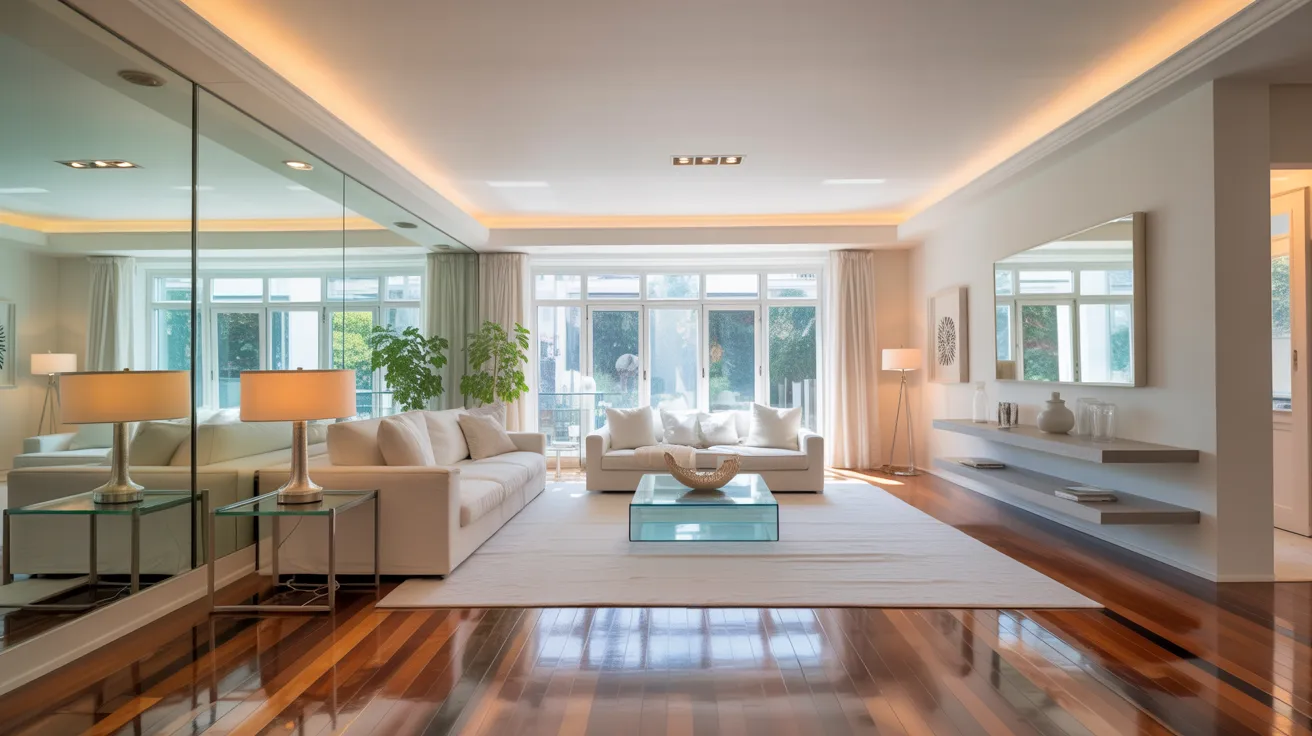
Designing for small or irregularly shaped rooms requires more than just taste; it calls for visual techniques that enhance the perception of space. With the right layout, lighting, and materials, interior designers can create environments that feel significantly more open than their actual dimensions suggest. Below are practical and effective visual tricks that make rooms feel bigger, especially relevant to high-end residential and design-led interiors.
Use Mirrors to Expand Depth and Light
Mirrors are among the most reliable tools in spatial illusion. When placed strategically, they reflect both natural and artificial light, amplifying brightness and duplicating visual elements to increase perceived space. A mirror opposite a window, for example, can create the impression of a second opening and visually extend a room’s boundary.
Beyond their optical effect, mirrors must be installed with attention to alignment, proportion, and surface type. In professionally curated interiors, the quality of mirror installation and hanging can make or break the intended design outcome, particularly in narrow hallways, bathrooms, or high-ceiling voids.
Opt for Low-Profile Furniture
Furniture that sits close to the ground and incorporates open space, such as legs instead of solid bases, helps reduce visual bulk. The more floor you can see beneath and around furniture, the more spacious a room feels. Sofas without skirted bottoms, armchairs with slim arms, and open-back shelving are ideal options.
Avoiding overfurnishing is just as important. Each piece should serve a clear purpose and be proportionate to the room. Removing bulky storage units or unnecessary side tables immediately opens up circulation and reduces clutter.
Stick to Light and Tonal Colour Schemes
Colour influences depth and spatial perception. Pale, cool-toned colours, such as soft greys, off-whites, and muted blues, reflect more light and help blur the lines between walls and ceilings. This reduces visual boundaries and creates a smoother, more expansive look.
Using a consistent colour palette across walls, trims, and even furniture reinforces the effect. In compact rooms, this tonal consistency is key to making the space feel unified rather than divided into competing sections.
Design Layouts That Maximise Sightlines
One of the simplest yet most impactful ways to increase perceived space is to ensure that nothing obstructs your line of sight. Clear sightlines from one end of a room to the other—or across open-plan zones—help the space feel uninterrupted and more breathable.
Float key furniture items slightly off the walls or windows to reduce cramped appearances. Maintain pathways of at least 80–90 cm between pieces to support physical and visual flow, particularly in high-use areas like living and dining rooms.
Use Reflective and Lightweight Materials
Choosing the right materials can enhance light diffusion and reduce heaviness. Glass, acrylic, and polished metals visually “disappear” compared to denser materials like wood or stone. These are especially useful in table tops, light fixtures, and accent pieces.
Glossy surfaces, when used selectively, also bounce light and make rooms feel more luminous. High-sheen tiles in bathrooms, glass splashbacks in kitchens, and metallic trims can contribute to this reflective palette without overwhelming the space.
Draw the Eye Up with Vertical Elements
Rooms feel larger when the ceiling appears higher. Floor-to-ceiling curtains, tall shelves, or vertical panelling can help create this effect. This vertical emphasis encourages the eye to travel upward, balancing out narrow or low-ceilinged rooms.
Even the placement of artwork contributes; arranging pieces in vertical pairs or columns adds height. Pendant lighting or ceiling-mounted fixtures can also shift focus upward while serving functional roles. When these elements are selected and positioned with careful attention to scale and proportion, they enhance verticality without overwhelming the space, reinforcing a sense of openness and balance.
Maintain Visual Simplicity and Avoid Clutter
Visual clutter is one of the biggest space-killers. Unnecessary decorative items, contrasting patterns, or mismatched colours can make a room feel chaotic and smaller than it is. Instead, aim for cohesion. Fewer, larger pieces often work better than multiple small ones.
Built-in storage or concealed cabinetry helps maintain clean lines. Open spaces between objects allow the room to “breathe,” making each element feel intentional and the overall space more expansive.
Perception Is the Real Space Multiplier
Space isn’t just physical—it’s perceptual. With deliberate use of light, layout, materials, and proportion, any room can feel bigger, brighter, and more refined. These visual tricks offer a practical foundation for designers working in compact or high-end spaces alike, enabling elegant solutions without the need for renovation.
