

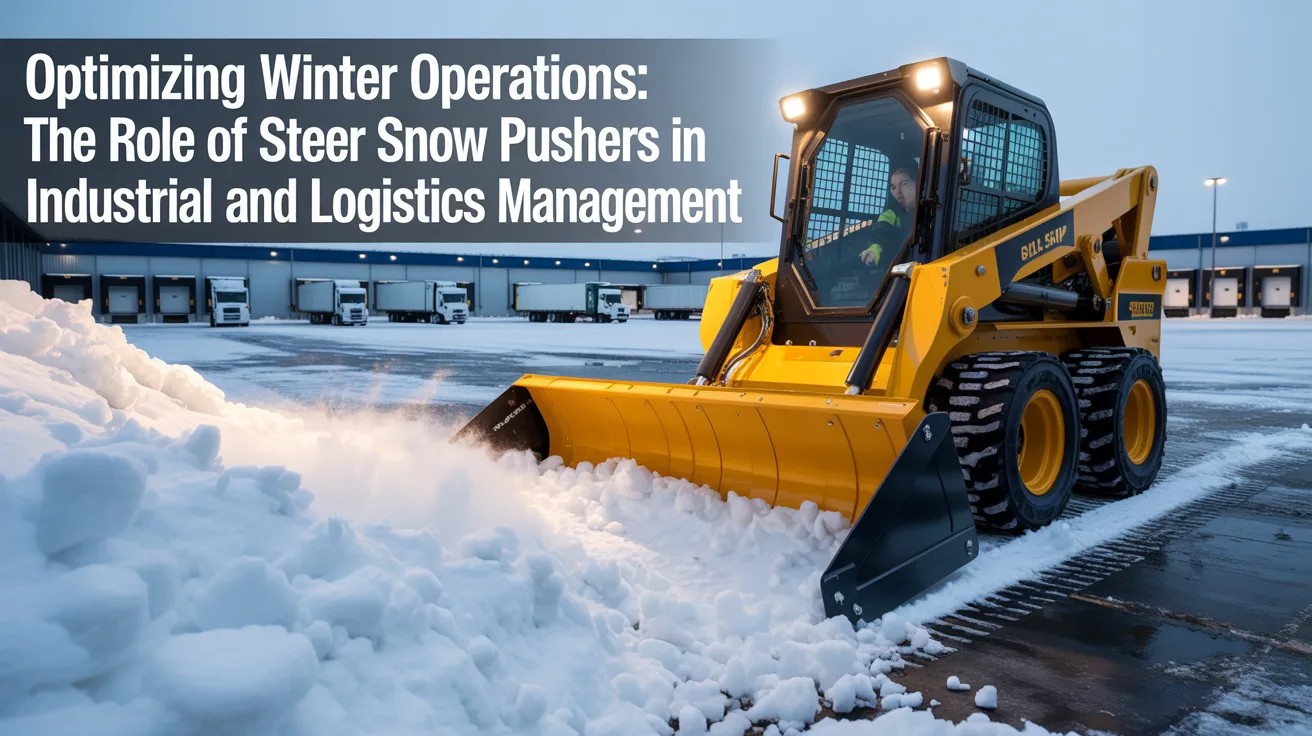
For industrial facilities, warehouses, and logistics centers across snow-prone regions of the United States, winter presents a significant operational challenge. Efficient snow removal is not merely a matter of convenience; it is a critical requirement for maintaining safety, ensuring regulatory compliance, and preserving business continuity. Among the most effective tools for this task is the skid steer snow pusher, an attachment designed to transform a versatile skid steer loader into a powerful snow-clearing machine. This article provides an in-depth examination of snow pusher technology, its application in industrial settings, and the key considerations for safe and productive winter operations.
Introduction and Operational Importance
Unmanaged snow accumulation can lead to blocked access roads, unsafe pedestrian walkways, loading dock obstructions, and increased risk of slips, falls, and vehicle accidents. Timely and efficient snow removal is therefore a core component of facility management. A skid steer snow pusher, such as a7’ Skid Steer Snow Pusher w/Steel Cutting Edge, offers a high-productivity solution. By attaching directly to a skid steer loader—a machine commonly already present in many industrial maintenance fleets—it enables rapid clearing of large, open areas like parking lots, yards, and driveways, keeping critical pathways open for personnel, suppliers, and customers.
Technology and Application Overview
A snow pusher is essentially a wide, flat-bottomed blade or bucket with a reinforced cutting edge. It is designed to slide along the ground, gathering and pushing snow in a straight line without the need for lifting and dumping cycles required by a standard bucket. The steel cutting edge is crucial for scraping packed snow and ice from pavement. In industrial and logistics contexts, its primary applications include:
- Clearing employee and visitor parking lots to maintain safe access.
- Opening and maintaining access roads and perimeter roads within large facilities.
- Clearing areas around loading docks and warehouse doors to ensure uninterrupted shipping and receiving.
- Creating snow piles or windrows in designated areas to maximize usable space.
The efficiency of a snow pusher lies in its ability to move large volumes of snow quickly over a distance, making it ideal for the expansive paved surfaces common to industrial sites.
Efficiency, Safety, and Productivity Impact
Efficiency is dramatically improved over manual methods or using a standard bucket. A wide snow pusher can clear a path in one or two passes that would require many cycles with a smaller tool. Safety is enhanced by allowing operators to clear snow from within the climate-controlled cab of a skid steer, reducing exposure to harsh weather and physical strain. Furthermore, a clear, well-maintained site directly reduces the risk of weather-related incidents. Productivity gains are measured in reduced downtime; faster snow clearing means employees, delivery trucks, and service vehicles can access the site with minimal delay, protecting the operational schedule.
Technical Foundations and Capacity Considerations
Machine Specifications and Compatibility
Key specifications for a snow pusher include width, material construction, and the type of cutting edge. Width, such as 7 feet, should be matched to the size of the skid steer and the typical areas to be cleared. The frame is typically constructed from high-strength steel, and the inclusion of a replaceable steel cutting edge is a critical feature for longevity and performance. Proper attachment requires a universal skid steer quick-attach system. Selecting a model like the 7’Skid Steer Snow Pusher w/Steel Cutting Edgerequires verifying that the skid steer’s operating capacity and hydraulic flow are sufficient to handle the size and potential snow load of the attachment.
The Role of the Cutting Edge and Design Features
The steel cutting edge is the workhorse of the implement. It makes direct contact with the ground, scraping away compacted snow and ice. A well-maintained, sharp edge is essential for effective clearing and to prevent the pusher from riding up over the snow. Some designs incorporate a slight curvature or “moldboard” to help roll the snow forward and prevent spillage over the sides.
Factors Affecting Performance and Operational Effectiveness
Several factors influence the success of a snow clearing operation with a pusher:
- Snow Conditions: Wet, heavy snow behaves differently than light, dry powder and requires different techniques.
- Surface Conditions: The presence of ice, uneven pavement, or obstacles like curb stops impacts the approach.
- Operator Skill: Proficiency in maneuvering the skid steer with a wide attachment and using float functions to maintain ground contact.
- Strategic Planning: Having a clear plan for where to push and pile snow to avoid blocking access or creating hazards.
Safety Considerations and Best Practices
Snow removal with heavy equipment carries specific risks that must be managed:
- Pre-Operation Inspection: Check the pusher, cutting edge, and all attachment pins for damage or wear before use.
- Clear the Area: Ensure the work zone is free of people, vehicles, and hidden obstacles like fire hydrants or parking blocks.
- Use Spotters: When visibility is limited or when working near buildings and corners, use a spotter to guide the operator.
- Understand Machine Limits: Do not attempt to push snow piles that are taller than the pusher or exceed the machine’s stability limits.
- Personal Safety: Operators should always wear seatbelts and understand how to safely enter and exit the cab on slippery surfaces.
Related Equipment and System Components
Effective winter operations often involve a system of compatible equipment:
- Skid Steer Loader: The power unit, which must be properly maintained for cold-weather operation (e.g., using winter-grade fluids).
- Alternative Attachments: Snow blowers or V-plows may be used in conjunction with pushers for different tasks or tighter spaces.
- Material Handling: Front-end loaders or larger equipment may be needed to relocate large snow piles created by pushers.
- Traction Aids: Tire chains or alternative treads for the skid steer can be critical for operation on ice.
Advantages and Limitations
Snow pushers offer distinct benefits but also have constraints:
- Advantages:
- Very high clearing speed for large, open areas.
- Simple operation with a low learning curve for experienced skid steer operators.
- Durable construction suitable for demanding commercial use.
- Cost-effective way to expand the utility of an existing skid steer.
- Limitations:
- Requires a sizable open area to push snow; not suitable for confined spaces.
- Can be less effective on very deep or densely packed snow without multiple passes.
- Does not lift or dispose of snow, only relocates it, requiring a planned dumping area.
Real-World Application Example
A large distribution center in the Midwest uses a fleet of skid steers equipped with 7-foot snow pushers. During a significant snowfall, the team deploys the pushers first to quickly clear the main travel lanes and parking areas, allowing shift changes to proceed and delivery trucks to access the docks. Once primary access is secured, they use the same machines with different attachments for detailed work around doors and sidewalks. This systematic approach, centered on the high-volume capability of the snow pusher, has reduced their average site recovery time after a storm by over 50%, ensuring they meet critical shipping windows.
Conclusion and Future Trends
The skid steer snow pusher remains a fundamental and highly effective tool for industrial winter maintenance. Its value lies in transforming a common piece of mobile equipment into a specialized, high-productivity snow-clearing asset. Key considerations for professionals include proper equipment matching, operator training focused on safe winter operations, and integrated site management planning. Future developments may focus on improved edge materials for longer wear, lightweight composite constructions to increase capacity, and perhaps integration with site telemetry for optimized clearing routes. As logistics and industrial operations continue to emphasize resilience and uptime, efficient snow removal strategies, supported by the right equipment, will remain a critical component of year-round operational planning.
